Friday, January 27, 2012

The Dick Van Dyke Show: A Classic That Never Gets Old

I used to watch The Dick Van Dyke Show years ago on TV Land (my go-to channel for classic TV, as opposed to TCM, which is my go-to for classic film). However, they stopped airing the episodes, presumably because there's so much classic TV out there and only 24 hours in a day to broadcast them all. I already find it frightening that they now air Everybody Loves Raymond as a "classic" show, when it isn't even a decade old. However, much to my surprise and delight, I discovered this week that The Dick Van Dyke Show is back on TV Land, with 2 half-hour episodes from 9-10 am that can really brighten up your day.

Created by comedy legend Carl Reiner, the show was always heralded for its witty writing and timeless episodes. I read Dick Van Dyke's autobiography last year and he mentioned that Reiner always wanted to keep the writing fresh with limited pop culture references so that the episodes would always have a timeless quality. Discounting the fact that the show is black & white, I would argue that it certainly is just as funny and relevant today, with stories and plot lines that can easily rival modern family sitcoms.

At the heart of the show are Rob and Laura Petrie, who are played by the rubber-limbed and charming Dick Van Dyke and multi-talented beauty Mary Tyler Moore. They had so much chemistry together that the show grew to include more of Rob's family life than had ever been intended originally. Laura is a former dancer, now stay-at-home mother of their son Richie, and she and Rob have a loving relationship where they are both equals. This is lovely to see when you know that things weren't always so pleasant among husbands and wives of that era. In fact, the episode I saw two days ago involved Laura temporarily going back to work as a dancer for a week, with Rob hiding his worries and doing his best to be supportive. Of course there's a lot of talk from his friends about how he should stop this nonsense before Laura decides to return to dancing full-time, and of course, he is thoroughly incompetent in the house, making his son endless frozen dinners that make them both miss Laura's cooking. But Rob can't "put his foot down" and deny his wife her dreams, which is what makes this a nice departure from all those other TV husbands (ahem, Ricky Ricardo) who were always quick to mock their wives if they ever thought of leaving the house.

The flip-side of the show concerns Rob's work life as a comedy writer on The Alan Brady Show, a fictional sketch comedy show. His fellow writers are Buddy Sorrell (Morey Amsterdam with a hundred wisecracks a minute) and Sally Rogers (Rose Marie). Sally is like the original Liz Lemon, hilarious, intelligent, always moaning about being single, yet clearly fond of her work. So really, with every episode of the Dick Van Dyke Show, it's like you get to watch Everybody Loves Raymond with some 30 Rock thrown in. These two very different settings allow for a lot of great plots, with scenarios that might be more concerned with what happened at home, what happened at the office, or like the episode when Laura works as a dancer for The Alan Brady Show, some explosive intersection of the two.

If you don't have TV Land, you can find all 159 episodes of the show on Hulu (what would we do without Hulu?!) and to start you off, here's an episode entitled, "The Night the Roof Fell In." It's a classic setup, where both Rob and Laura have had bad days and when they expect some empathy in the evening, they instead get into a fight over who had it worse. Things escalate, but what makes the script so particularly funny and Coupling-esque, is the way that the fight is re-enacted twice, once when Laura is talking about it with her neighbor, Millie (the wonderful Ann Morgan Guilbert, who you may recognize as Yetta, Fran's batty grandmother on The Nanny!), and another time when Rob tells his tale of woe to his colleagues. The audience knows exactly what happened in the fight, but it's hilarious to see these two characters tell VERY different versions of how they behaved, what was said, how they were completely in the right, while the other person was so horrid.

The Dick Van Dyke Show is an excellent example of how great comedy can be mined from simple everyday mishaps. The show's writers often used stories from the cast and crew to come up with ideas for the show. One of the funniest sequences in the show's history occurs in an episode entitled, "The Cat Burglar," when the Petries think someone's in the house and Rob grabs his gun for protection. However, Laura had previously taken out the bullets and stored them in her jewelry box. Unfortunately, the box is a musical one and Rob's attempt to be stealthy is quickly defeated by the fact that every time he attempts to retrieve a bullet, he is treated to a loud rendition of the Blue Danube Waltz. As fantastical as the premise sounds, it is based entirely on a real-life incident with Dick Van Dyke and his wife at their home.

This anecdote only goes to show you that life itself is a comedy. You just need some great writers to throw in witty dialogue, some actors who can perform marvelous feats of physical comedy, and you get a 25-minute piece of television gold.


Wednesday, January 25, 2012

Paradise Lost: A Documentary Trilogy That Called For Justice

HBO's Paradise Lost was a documentary released in 1996 that followed the trials of three teenage boys in West Memphis, Arkansas, who were convicted of the brutal murder of three eight-year old boys in 1993. The filmmakers, Joe Berlinger and Joe Sinofsky, spent 79 days over a 10-month period in Arkansas interviewing the families of the victims, the accused teens, the police, lawyers, and everyone else involved in the case. What initially set out to be a straightforward documentary, however, turned into a probing look at how this investigation was being conducted, and a growing certainty on the part of the filmmakers that these three teenagers were actually innocent.

The details of the case would take too long to go into here, but the gist of it is that the West Memphis Police Department became convinced that the murders were part of a Satanic ritual. And their suspicions immediately fell on 18-year old Damien Echols, a kid who wore black, professed to be Wiccan, liked listening to heavy metal music, and must therefore be a Satanist. The police brought in another suspect, 17-year old Jessie Misskelley for questioning, and by the end of a 12-hour interrogation (only 45 minutes of which were taped), Misskelley confessed to being present at the crime scene and helping Echols and his friend, the 16-year old Jason Baldwin, murder the three boys. This led to the arrest of all three boys, and subsequent trials and convictions that were all documented by the Paradise Lost crew. Throughout the trial, the boys maintained they were innocent and serious doubt was thrown on the validity of Misskelley's confession. Miskelley had an IQ of 72, was alone during his interrogation and claims he didn't understand his Miranda rights, and the tape of his confession clearly shows him getting the details of the crime wrong but gradually being led by the police to change his story so that his details would fit the facts. Most startling of all was the vitriol that Echols faced simply due to his different appearance and behavior and everyone's utter certainty that he must be a devil-worshipping murderer. The three teens were convicted in 1994, with Baldwin and Miskelley receiving sentences of life imprisonment and Echols receiving the death penalty. 

When Paradise Lost was released, it incited a lot of discussion and a growing concern that these boys had been misrepresented and wrongfully convicted. Aside from Misskelley's "confession," there was no definite evidence linking them to the crime and they largely seemed to have been convicted on the basis of irrational fears of people who wore black and listened to Metallica. The trio became known as the West Memphis Three and a website was started to inform the public and get donations for a fund to help the defense find experts to examine the evidence and appeal the court's decision. So in 2000, the sequel, Paradise Lost 2: Revelations, was released on HBO, which detailed the growing Free the West Memphis Three movement and the involvement of forensic experts and criminal profilers who were adamant that these three boys could not have commited a crime of this magnitude. They didn't think there was anything Satanic about the crime scene and there was increasing suspicion placed on the stepfather of one of the boys, who appeared to be unstable and could quite possibly have been the one to commit the murders in the first place. You really have to watch these documentaries to see the twists and turns that the case takes, and at one point, the film crew find themselves in possession of a knife that they have to turn in as evidence that could possibly be linked to the case. The whole thing has the tone of a compelling murder mystery that would make great fiction but is unfortunately highly tragic fact. 

Last night I watched Paradise Lost 3: Purgatory, the final installment in the saga of the West Memphis Three. It was released on HBO just a few weeks ago, almost 12 years after the last installment, and was initially meant to revisit the case and new evidence that had come to light. In 2007, new DNA evidence was found that could not be linked to the West Memphis Three and therefore further supported the idea that they were not involved in these murders. Some of the DNA actually matched another family member of one of the murdered boys, who was also found to be lying about when he had last seen the boys, which goes to show that even decades after a crime, investigative work can still turn up new leads. The documentary followed the lawyers' attempts to get the Arkansas Supreme Court to admit this new DNA evidence and grant a re-trial for the three boys (now men) with further allegations of juror misconduct and evidence that the initial trial in 1994 was deeply flawed. All this time, Echols, Baldwin, and Misskelley have undergone numerous failed appeals and have spent 18 years in prison. That is 18 years more than they ever expected when they were first arrested and were certain that no one could imprison them for a crime they did not commit. 

It is startling to see the evolution of these documentaries, both thematically and cinematically, but most importantly, the evolution in the characters that make up this real-life tragedy. The West Memphis Three started out as three bewildered teenagers and have now grown into 30-something men, who have spent more time in prison than they ever spent as free men. Damien Echols had a newborn son when he went to prison; his son is now the same age as his father was when he was arrested. And yet, all three men are remarkably calm, resigned to their current fate, but staunchly declaring their innocence and grateful for all of the help from the West Memphis Three groups who have been fighting for years to find new evidence and find new experts to convince the state of Arkansas to overturn these wrongful convictions. 

The truly great moment of Paradise Lost 3 is the epilogue. The movie was meant to be released in the fall of 2011, but was pushed back to 2012 when the filmmakers had to rush down to Arkansas for a circuit court hearing that was abruptly called to discuss the case on August 19, 2011. On that day, the defense lawyers worked out a deal with the state, allowing the West Memphis Three to enter Alford pleas. The Alford plea is a bizarre legal maneuver that allowed the men to declare that they were innocent of the crime, but still plead guilty to lesser charges and be set free since they had already served 18 year sentences. In one very emotional moment, Jason Baldwin declares that he didn't want to take this plea because it was unjust to plead guilty to a crime he didn't commit. But he accepted the plea because Damien was still on death row and could not afford to lose any more appeals or be found guilty in a re-trial.

So the West Memphis Three are now free men, thanks in part to a series of documentaries that never stopped looking for the truth and thousands of people across the globe who supported them and funded the defense team so that new evidence could be brought to light. The story is bittersweet - by entering Alford pleas, justice hasn't really been done, because these men are still considered guilty of the crime and the real killer hasn't been found. But as Damien Echols says upon his release, he can now work outside of the prison to continue the investigation. The story is by no means over. 

Tuesday, January 24, 2012

A Letter to Three Wives: Three Leading Ladies Versus One Vamp

Oscar nominations came out today but rather than discuss a recent movie, this post is about a 1949 Oscar winner for Best Directing & Writing. Starring the wonderful trio of Jeanne Crain, Linda Darnell, and Ann Sothern, A Letter to Three Wives is one of those comic masterpieces that boast powerhouse performances, a tight script packed with whip-smart dialogue, and an improbable but hilarious premise that keeps you guessing till the very end.

The movie opens with the narrator, a woman named Addie Ross who snarkily introduces us to her three so-called "friends," Debra Bishop (Crain), Rita Phipps (Sothern), and Lora Mae Hollingsway (Linda Darnell in a scene-stealing performance as a poor girl trying to make it with a rich man). It's a Saturday morning and the three women are getting ready to volunteer at a children's picnic while their husbands have all begged off with some excuse or the other. When they get to the dock (they have to take a boat to get to the picnic site), Lora Mae reports the news that Addie Ross has disappeared. She rented out her house, grabbed her things, left town overnight, and no one knows why. Just as they are speculating, a messenger arrives with a letter from the missing Addie. Bursting with curiosity, the women tear it open. After some simpering declarations of how much she will miss her three best friends, Addie drops her bombshell. She has run off with one of the three women's husbands, "so that she will always have something to remind her of her three best friends."

The stunned women board their boat and head for the picnic. With no access to a phone, they are forced to wait until the Country Club dance later that night to discover whose husband won't be showing up. As their day progresses we see three different flashbacks that tell us something about each woman's marriage and why she has reason to worry that her husband might be the one who has run off with Addie. And as you see their stories unfold, you become just as impatient as they are to return home and discover who is going to be alone at that dance.

The ending is neatly tied up and is appropriately warm and satisfying, characteristic of the comedies of that era. Writer-director Joseph L. Mankiewicz won two Oscars for this movie, a feat he repeated the next year for the much more famous All About Eve. He seems to have excelled at directing movies about interesting and clever women and got great performances out of these already great actresses. The actors playing the husbands are also a fine lot, including an unrecognizable Kirk Douglas in a much lighter and comic role than usual. Ultimately this is not the dark Oscar fare we've come to expect, but a much more effervescent and charming film that will keep you entertained for a solid two hours.

This movie was featured as one of The Essentials, a weekly feature every Saturday at 8 pm on Turner Classic Movies. Look for this channel on your cable line-up if you haven't already - it's my go-to whenever I need to indulge in some classic cinema fare. The great thing about old movies is that they're widely available, so if you don't have TCM, you can still check to see if your local library has a copy on hand. And failing that, there's another ingenious option. A lot of these movies were adapted for radio and there are online archives of the original broadcasts. I made a marvelous discovery yesterday: the Screen Guild Theatre broadcast a 30-minute adaptation of this movie with Linda Darnell and Paul Douglas reprising their roles, and you can listen to the whole thing at this link (scroll down to # 342 on the media player). This archive features over 300 adaptations of other masterpieces like The Philadelphia Story, Suspicion, Laura, etc., so if you needed some audio entertainment, you're covered for the foreseeable future.

Many people scoff at old movies and their eyes glaze over at the mere sight of black & white cinema. But lack of color does not equate to lack of sophistication. The actors are stellar, the stories well-crafted, and the scripts are deft and agile. Comedies of this era had to be extra devious and witty to get by all the censors, and the scripts are often packed with double entendres that will make your head spin. If you needed any more evidence that A Letter to Three Wives is a true classic, I offer you incontrovertible proof: the movie was parodied in an episode of The Simpsons entitled, Moe Letter Blues.

I'm not saying all old movies are great. There are plenty of duds among them, just like for every Hugo or The Descendants of our modern age, we get another awful Adam Sandler "comedy". But don't be quick to dismiss all old movies, because there are true gems among them that still deserve to be seen and revered. After all, these movies were winning Oscars long before anyone named Clooney, Scorsese, or Streep came along.

Sunday, January 22, 2012

Arthur Christmas: Even Santas Need Help Getting Into the Christmas Spirit

I know it's late to be touting a Christmas movie, but since you're probably wishing you had a day off again, you might be open to some Yuletide cheer. And Arthur Christmas is just the movie for the job. Brought to you by the brilliant people of Aardman Animations (the ones responsible for the stop-motion claymation wizardry of Wallace & Gromit), this film will enchant and delight you from the very first second.

Unlike Aardman's previous claymation works, this movie is presented in straightforward computer animation (with 3D in select theatres of course, but I didn't see the 3D version). It looks beautiful, just as well thought-out and designed as their previous films, although presumably requiring a lot less manpower and time to create. The story is set in the modern-day North Pole, where Santa's annual mission to deliver presents to the 2 billion children of the world is a vastly technological enterprise, complete with a high-tech sleigh that is the size of a small city and contains ports through which elves can rappel down, drop off a present in their designated house, and race back up within a few minutes. Santa (real name: Malcolm) is mostly a figurehead who is guided by elves to drop off presents in a few houses and look like he's keeping up the Christmas spirit. The man working behind the scenes is his son, Steve (voiced with sneering glee by Hugh Laurie), who coordinates all the satellites, GPS navigators, and thousands of elves that go into making Christmas run as smoothly as possible. Steve is all about efficiency and guzzling espresso, in stark contrast to his younger brother, Arthur. 

Voiced charmingly by James McAvoy, Arthur is the bumbling, clumsy son, sentenced to work in the mailroom where he answers all of the letters to Santa written by children across the world. Even though Arthur wreaks havoc if he sets foot in the control room, knocking over elves and inadvertently flipping switches or setting off alarms, he is thoroughly invested in writing back to these children and looks forward to Christmas with more happy anticipation than anyone else in his family. For everyone else, Christmas is the family business, something they have to do perfectly and then be done with on December 25th. But for Arthur, Christmas is the greatest day of the year, featuring the greatest man he knows - his father, Santa.

The trouble arises when the night's mission is seemingly over and everyone is getting ready for bed. A gift-wrapping elf named Bryony (a hilariously squeaky Scottish creature voiced by Ashley Jensen) is clearing up the control room when she discovers a gift that (gasp!) didn't get delivered. Somewhere in Cornwall, there's a little girl named Gwen who won't get the pink bike she asked for. Naturally this breaks Arthur's heart, but his father and Steve just shrug it off as being within the margin of error. But Arthur can't let it go so he teams up with Bryony and his granddad (Grand Santa, who has ulterior motives of his own for this act of decency) to race to Cornwall before sunrise and deliver Gwen's present.

The movie proceeds with whimsy, heart, and hilarity, the combination you'd expect from an Aardman picture. There are sight gags and one-liners littered throughout the film and while young children will love the animation and story, only adults can truly appreciate the humor. The voice actors do a splendid job and the story is a surprising and fun twist on the classic tale of Santa up at the North Pole with his reindeer and sleigh. The ending is appropriately heartwarming and the journey you take to get there is fantastic. 

With Arthur Christmas, Aardman Animations has revealed that they are a force to be reckoned with in computer animation. This movie didn't do that well at the box office, probably because most people think any non-Pixar animated film is a waste of time and aren't aware of Aardman's pedigree (come on, they won an Oscar for a Wallace & Gromit short!). But I hope the film gains a wider audience and appreciation upon its DVD release. If Aardman continues to make movies with such excellent scripts, actors, and characters, it won't be long before everyone will be impatiently awaiting the next Aardman Animations release, right alongside that Pixar summer blockbuster.

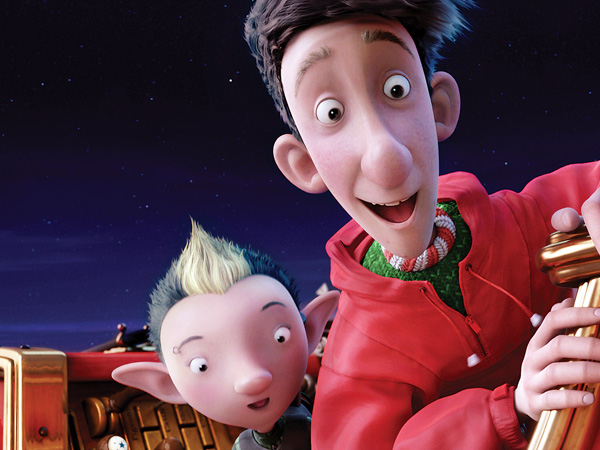
Arthur & Bryony: a man and an elf on a mission

Wednesday, January 18, 2012

War Horse: Galloping Through History

War Horse did not make me cry. And after watching the movie, I must confess some surprise at all the acclaim and Best Picture nominations and stories of grown men reduced to tears. Even if Joey, the horse at the center of War Horse, is as relatable as any human soldier going into battle, this is a level of cinematic adoration that's beyond me.

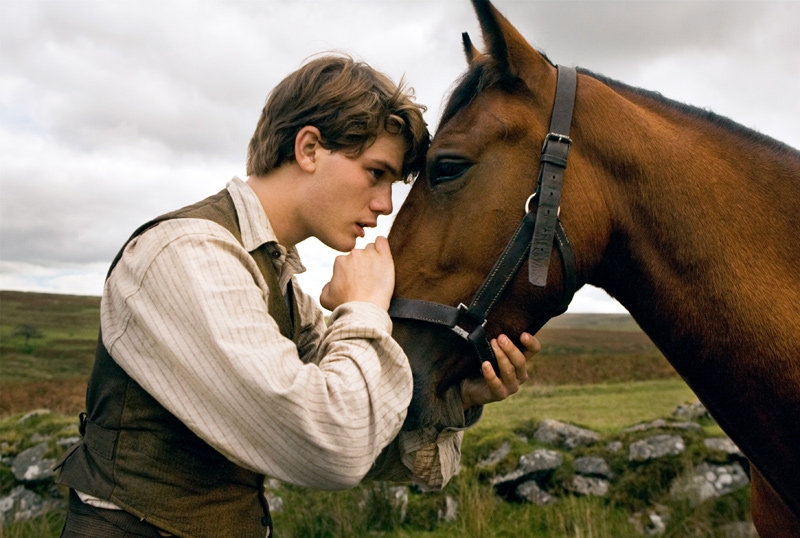
The story is based on a children's novel by Michael Morpurgo and is fairly straightforward. We are introduced to Joey at the moment of his birth. He is purchased by an English farmer after a very rash auction bid, but his son Albert (Jeremy Irvine in his very first film role), persuades his parents that he can train this horse to be a serviceable plough horse. Albert has no equestrian experience but over the course of training Joey, the two develop a deep bond and love for each other. Unfortunately, 1914 dawns, bringing with it the Great War. Albert's father, without consulting his son, decides to sell Joey to a cavalryman, Captain Nicholls (Tom Hiddleston). Albert finds out and races to Joey's side but the sale is final and he has to say goodbye to his beloved horse.

As the movie progresses you follow Joey's dangerous and fateful journey through cavalry charges and barbed-wire trenches, as well as his encounters with German soldiers, French civilians, and a host of people who are just trying to make it through the war alive. Time and time again Joey is miraculously saved from death, and despite the allegiances of the people who take charge of him, they are all horse lovers who feel an instant affinity and protective instinct for this magnificent animal.

This is a tale of one good thing that happened amidst all the horrors of warfare. All the killing and brutality of World War I is present but mostly in the periphery where it could be missed by young viewers who are more concerned with the action that's right upfront. It barely merits its PG-13 rating and probably flies as PG in other countries. This is a great film for children, an age-appropriate introduction to one of the worst events of human history. And let's not forget, it's directed by Steven Spielberg, a master at setting the scene, relating a compelling story, and no stranger to making a war movie. The film is visually stunning, but it feels slow and consists of multiple set pieces to show how Joey gets from one place to another before he is finally reunited with Albert. There is one scene however that I genuinely loved. It takes place near the end and involves the No Man's Land between the English and German trenches. The soldiers from both sides spy Joey who is trapped in some barbed wire and what follows is one of those grand moments when soldiers recognize their common bond as human beings and put their political differences aside.

Most people I know loved War Horse much more than I did, so you could probably watch it and agree that it is a masterpiece. My ambivalence is due to the fact that I need my war movies to be slightly less sugarcoated. I have nothing against movies based on children's books (after all, I thought Hugo was one of the most stunning films of the year), but when your topic is World War I, it takes a little more than a story about a boy and his horse to really draw me in.


Monday, January 16, 2012

The Girl With the Dragon Tattoo: Kicking Ass and Taking Names

I planned to watch The Girl with the Dragon Tattoo when it released on Christmas Day, but somehow other movies intervened and I only watched it last weekend. This was a grievous delay because this movie is amazing.

I was a huge fan of Stieg Larsson's Millenium trilogy featuring intrepid Swedish journalist Mikael Blomkvist and the tattooed, pierced, and brilliant hacker Lisbeth Salander. The books are nail-biting thrillers that feature villains who never seem to stop getting more evil and each chapter brings more horrors and delights. The Swedes have already filmed the entire trilogy, with Noomi Rapace playing Lisbeth and Michael Nyqvist playing Mikael. I only saw the first movie and it was great. However, the joy of watching this Hollywood version is that it has amped up the production value while still remaining insanely true to the books. In fact, as transformed as Noomi Rapace was in the characater of Lisbeth, Rooney Mara probably fits the bill even more as the scrawny yet fierce woman who spends the film wreaking vengeance upon her enemies and helping Blomkvist (played by the ever-marvelous Daniel Craig) find a "killer of women." 

I knew I would love this movie just from the opening credits which feature a series of dark fluid images set to Trent Reznor & Atticus Ross' pulse-pounding score, with Karen O's shrieking vocals thrown in for good measure. This is a David Fincher movie through and through and even if the subject matter wasn't so compelling, I'd have loved the movie for its visuals alone. The snow-covered Vanger estate will make you shiver and you just can't tear your eyes away from the screen as you watch Rooney Mara get even with her enemies. The brutality of the books is not sugarcoated in any way and some scenes will certainly make your stomach turn. But what surprised me the most was how Fincher still managed to inject plenty of humor into this film. The audience I watched this movie with was particularly keen to laugh uproariously at every one-liner, perhaps due to their need for catharsis after all the rape and dismemberment. 

The actors are all pitch-perfect in their portrayals of these well-known characters and the film proceeds at a fierce pace that keeps the adrenaline going. The only jarring note is that Craig does not seem to have a Swedish accent at all. Everyone else pulls off some semblance of an accent (Mara probably does it best) but Craig sounds completely English, which led me to wonder if he ever does accents in his other films. I think he just clenches his jaw, enunciates less, and hopes that he doesn't sound too English. But despite this minor blip, he is a fine Blomkvist and is the ideal complement to Mara's Salander. 

I am shocked that the movie hasn't received more attention for awards this year. Rooney Mara is deservedly being lauded for her performance and got a Golden Globe nomination (though unbelievably she wasn't nominated for the SAG or Critics Choice Awards), but the movie itself ought to be recognized as the masterpiece that it is. The American Film Institute and National Board of Review have listed the movie in their Top 10 Films of the year, but I fail to understand why it didn't get nominated at the Golden Globes or Critics Choice Awards. Hopefully the Oscars will rectify this oversight, because David Fincher should be receiving Best Director nominations all over the place and the film needs to get some major love. It hasn't performed too well at the box office, but this was a hard movie to sell as Christmas fare and I can only hope that more people go to see it now that the holidays are done with. 

The day after watching this film, I woke up with a craving for coffee and open sandwiches and I am still suffering from The Girl with the Dragon Tattoo withdrawal. For now I'll console myself with the Swedish films, but I cannot wait for Fincher, Mara, and Craig to return and finish up the trilogy in style. 

Sunday, January 15, 2012

Tinker Tailor Soldier Spy: A Movie That Will Make Your Head Hurt (In A Good Way?)

Tinker Tailor Soldier Spy is one of those quintessentially British movies that you get every award season. An all-star cast with familiar British faces (Gary Oldman, Colin Firth, Mark Strong, John Hurt) and the rising stars (Tom Hardy, Benedict Cumberbatch), it's a recipe for greatness. Plus it's based on a great novel by John Le Carre and they're all playing MI6 agents: what could go wrong?

Well, depends on who you ask. I thought it was a great film. But I am also a massive Anglophile who thinks anything with Colin Firth has to be a hit. Truth be told, this movie is a bit of a struggle to understand, an opinion that was shared by my friend Christina who saw the film on the same day as me. When we got to talking, we discovered that both of us had identical reactions once we got home. We went on Wikipedia and read the film synopsis. And I believe this will be most people's reaction. The movie is so intricately plotted and twisty that no matter how hard you try, you're going to find yourself lost on some plot point or the other, and that is when Wikipedia is your friend.

The movie is set in the 1970s and follows George Smiley (Oldman), a long-serving agent who has been forced into retirement but is brought back for a covert mission to identify a Soviet mole in the upper echelons of MI6. There are 4 suspects and their code names are Tinker, Tailor, Soldier, and Poorman. Smiley was himself a suspect (codename: Beggarman) but is now considered trustworthy enough to take over the investigation and determine whose codename should really be "Spy." Unlike that other British spy franchise, Smiley is no James Bond. He spends most of the movie sitting in an armchair, sipping some whiskey, and going through reams of paperwork. Indeed, this movie is perhaps the most accurate depiction of what it means to be a spy. Instead of waltzing about in tuxes, notching bedposts, and blowing up villains from their Aston Martins, these spies are clad in tweed, reading over typewritten telephone transcripts and desperately hoping for a telegram that will give them a lead in their investigation.

There are several flashbacks as Smiley considers his colleagues and tries to figure out which of them could be a traitor. Perhaps I was spoiled by Lost, where every flashback was preceded by that whooshing sound that alerted you that you would be jumping backwards (or forwards) in time, but Tinker Tailor does no such thing, which often leaves you highly confused as to whether you are witnessing the past or the present. Sometimes it is very evident, but at other times it is remarkably confusing. I spent half an hour convinced that one of the scenes was a flashback only to discover that the man I thought was dead was actually very much alive and that scene was in the present.

The other problem is the vast array of characters. Unfortunately Colin Firth's character is not named Colin Firth: sometimes people refer to him as "Bill," other times as "Haydon." Since Firth isn't the only character with a name, you are faced with a mass of jumbled first names and last names of all the suspects, all the investigators, all the villains, etc. and untangling them all will make your head spin. So it took me about an hour to finally consolidate the fact that Firth's character was named Bill Haydon and not Bill Bland, or Jim Haydon, or whatever.

These difficulties aside, the film boasts an impressive production design, with costumes and sets that will steep you in the atmosphere of 1970's Britain. It has the look and feel of an old-school spy thriller and even if there isn't much action, the moments leading up to the discovery of "Spy" are just as suspenseful and nerve-wracking as any high-octane thriller. Every single actor gives a fantastic performance and they look like they are having a grand time playing MI6 agents, as you hope they would.

Overall, this is an impeccable period piece that pays homage to the fact that being a spy was really messy work 40 years ago when you didn't have computers and gadgets to streamline the proceedings. Maybe the difficulty in following the plot is actually meant to make you feel like a spy yourself, desperately trying to follow up the leads and untangle the information before the final denouement. After all, by the time I was done discussing the film with my friend and going over all the loose ends I had missed, I felt like I had completed a covert mission of my own.

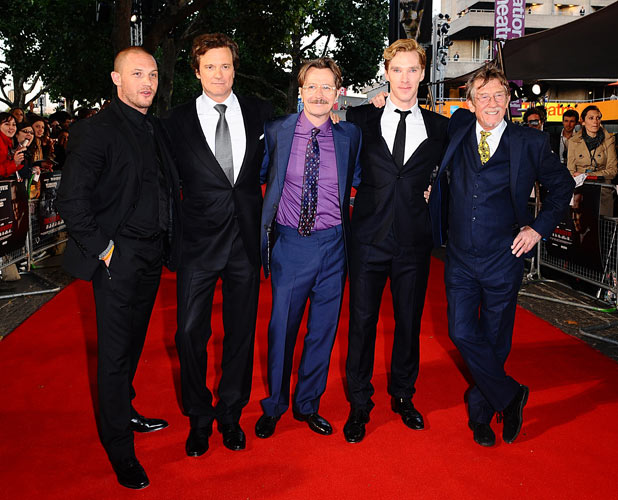
Just a few of the stellar Brits that make up the confusingly-named cast of characters.