Wednesday, June 27, 2018

The Tale: The Pain of Remembering

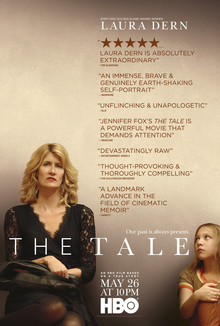
The Tale is a movie I dreaded watching but found so compelling that I was really glad I saw it (thought I don't ever watch to re-watch it). So, I'm recommending it, but also with the caveat that it will disturb you and make you want to never let your children out of your sight ever again.

The luminescent Laura Dern plays Jennifer Fox (the writer and filmmaker of this movie; this is a true story about her dawning realization about an incident in her childhood). Things kick off when Jenny gets a call from her mother who has just discovered an old story Jenny wrote when she was 13. Her mother is very upset, but Jenny dismisses her concern, telling her she's making a mountain out of a molehill. What follows is a chilling story that is told in a hazy and erratic way I've never seen before as Jenny tries to piece together her memories. There are flashbacks to the summer when the incident took place, where we get to see how 13-year old Jenny (Isabelle Nelisse) first met the enigmatic Mrs. G (Elizabeth Debicki) and a running coach, Bill (Jason Ritter). And how they slowly gained her trust and eventually subjected her to something that she wouldn't truly understand until the present when she is old enough to realize what exactly happened to her that summer.

This movie is a wondrous piece of storytelling, weaving back and forth through Jenny's diaphanous memories, anchored by her narration that only gives up bits and pieces of this story, making you relive her experience as a young child. You can easily see how this woman has spent her entire lifetime believing that what happened to her was perfectly normal, but watching the cracks appear as she researches this story and interviews people from her past is devastating. She is a journalist who focuses on women's stories and sexual abuse, and to watch her dawning horror that she herself experienced this and isn't just some objective outsider chronicling other's experiences is devastating. Laura Dern and Isabelle Nelisse are a heartbreaking duo as old and young Jenny, and they will be sweeping awards for their performances in the very near future.

In the #MeToo world, stories like The Tale have even more resonance and urgency. Young women are trained to rationalize and justify so much bad behavior - no he's my boyfriend, he's my husband, this is how it is, etc. This movie is an exquisite deconstruction of how that type of thinking is ingrained into us as young girls and perpetuated into adulthood. Even the parents, who suspected what was happening, were so horrified by the taboo that they chose to believe it couldn't be happening rather than consider reality. The takeaway from this movie shouldn't be to lock up your daughters. But it should certainly be to talk to them openly about sexuality and what they deserve. Rather than masking the topic in an aura of uncertainty, which then leads to women keeping secrets and letting themselves live with shame rather than speaking out against the truly shameful people they encounter. 

Friday, June 22, 2018

Wild Wild Country: A Captivating Cult

I have always been wary of spiritual gurus but never more so than after I binge watched Wild Wild Country over two days. If you have not watched this documentary on Netflix yet, hunker down this weekend and get to work. You'll be treated to the most disturbing and entertaining six hours you've experienced in a while.

The six-part documentary tells the story of Bhagwan Shree Rajneesh (later known as Osho) and the cult he built in India, which he then subsequently transferred to the tiny town of Antelope, Oregon in the 1980s. Over the course of the documentary we get the story from Rajneesh's followers (the Rajneeshees) and his deputy, Ma Anand Sheela, one of the most intriguing women ever featured on screen. She is the ultimate antihero, a woman with almost psychopathic ambition and a fervor to do anything for her guru until things become too much even for her. We also get the story from the white, conservative residents of Antelope, Oregon, who had their lives completely changed by the arrival of this strange cult.

The first few episodes make it seem like your typical struggle between conservative Americans and immigrant foreigners. In our political climate, it seems convenient as a liberal snowflake for me to side with the foreigners and get mad at the white people for being so confrontational and annoyed about these people pouring into their town. However, once you learn more about Sheela's tactics and the way this cult started to take over local and state politics to further their radical agenda, you start to understand that no one's got a leg to stand on here. Pretty much everyone involved is a monster, and as the list of crimes by the townspeople and the cult members start to escalate, you have to pause and say, "Wait, this really happened?"

That's the most absurd thing about this story. It all took place in the 1980s and yet this is the first I've ever heard of it. My mother vaguely remembered it, but I suspect that was just because of the sexual escapades of the cult (the reason they got forced out of India) and not the other craziness that ensued in Oregon. Free love is a tame scandal compared to poisoning, tax evasion, voter fraud, and attempted murder. Yeah, these people really got busy. And the documentary is full of news clips that reveal this was national news that had the country obsessed, with Tom Brokaw and the like talking about the Rajneeshees and debating how the FBI was going to take everyone down.

Wild Wild Country is a brilliant documentary, ending every episode with a compelling cliffhanger that will have you desperately hitting "Play Next Episode" so you can watch what happened to these seemingly normal talking heads who start spewing increasingly bizarre stories about this cult and what happened in Oregon. Netflix is fast becoming my go-to source for quality documentary filmmaking and I won't be surprised if Wild Wild Country picks up a ton of awards this year for captivating a nation and reminding us how quickly a charismatic leader can lead his people to complete ruin.

Monday, June 18, 2018

Hearts Beat Loud: Love & Music in Brooklyn

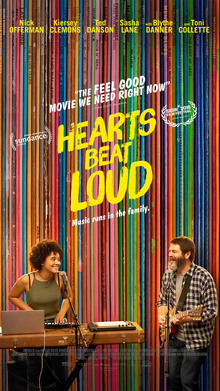
Every once in a while, your cool friend (hi Katie!) will urge you to go to the theater to watch a little indie movie that's bursting with heart and ambition. Hearts Beat Loud is one of those films. A movie about the relationship between a father and daughter, about making music, about finding love, it's a sweet and magical little gem that is guaranteed to put a goofy grin on your face and make you hum its title song for the rest of your day.

Nick Offerman stars as Frank, the owner of a Brooklyn record store and father to Sam (Kiersey Clemons), a very serious teenage girl who is spending her summer before heading off to UCLA taking pre-med classes so she can be better prepared to get a research internship. Her father is trying to get her to enjoy her summer and insists that she join him in some jam sessions instead of doing homework 24/7. Reluctantly she agrees, and he discovers that she has been jotting down some lyrics, inspired by her budding romance with a local artist (Sasha Lane). They record a song, Hearts Beat Loud, a gorgeous indie confection that has a hook that will haunt you for days. Unbeknownst to Sam, Frank uploads the song to Spotify, where it slips its way into the Daily Indie Mix playlist and excites some interest. Thus arises the question of whether Sam should pursue college or go on tour with her dad and pursue her musical talent.

Yeah, that's where all the parents (particularly non-American ones) reading this blog roll their eyes and say there's no question there. But this is a movie about Brooklyn hipsters, OK, so pursuing art over a medical career is a legitimate option. This is certainly a very Brooklyn movie, where the father doesn't bat an eyelash over learning about his daughter's girlfriend, but is annoyed that she would rather do her science homework instead of playing with the new sampler he bought. But it's also a very sweet father-daughter relationship built on trust and mutual respect. It reminded me of Toni Erdmann, with the father desperately trying to make his uptight daughter relax, except here, the daughter is plenty cool all on her own and just needs to be reminded that she can sing and study at the same time. It also reminded me of Begin Again, a similarly sweet movie about musicians in New York that got lost in the morass of summer blockbusters in 2014, so don't let this movie suffer the same fate.

Hearts Beat Loud is the ideal summer movie - light and breezy, not too serious but packed with dazzling performances from character actors you don't often get to see on the big screen. Toni Colette, Blythe Danner, and Ted Danson toss in charming supporting performances, but Nick Offerman rules the screen until he's upstaged by Kiersey Clemons, who is destined to be a star. The soundtrack by Keegan Dewitt (featuring mostly original songs) is wonderful, and a certain moment in the film has ensured that Mitski's Your Best American Girl is now on repeat on my iPod. At one point, when Sam dismisses her song lyrics as not being about anything, her father tells her that sometimes it's just about the feeling. Well, this movie will certainly make you have all the feelings. So if you want a positive, beautiful movie about people who love each other and have a lot of talent, treat yourself to this film ASAP.

Sunday, June 17, 2018

Ocean's 8: The Girls Are Back in Town

Ocean's 8 is here and all's well with the world. OK, no, misogyny and the threat of a nuclear holocaust are still rife, but at least I got to go to a movie theater for two hours and enjoy the most unabashedly female movie of the summer.

A reboot of the Ocean's 11 franchise, this movie is an effervescent delight that recalls everything that was great about the original movie (when I say original, I mean the 2001 remake, not the original 1960 film starring the Rat Pack). It gets the two most important elements exactly right: the cast and the heist. The heist needs to be an intricately plotted, dizzying spectacle that is just a little too audacious but still plausible, while the cast needs to be a gang of actors who can banter with each other and bring their individual charms and skills to the table. Considering Sandra Bullock and Cate Blanchett are the equivalents of Clooney and Pitt in this film, I'd say the casting director deserves an Oscar.

Bullock and Blanchett aren't the only casting coup, however. We also have Mindy Kaling, Sarah Paulson, Helena Bonham Carter, Rihanna, Awkwafina, and Anne Hathaway. Instead of the bro-y landscape of Las Vegas and ostentatious casinos, this movie is set in New York at the annual Met Gala, and the target is a $150 million Cartier diamond necklace adorning the neck of a very obnoxious leading lady, Daphne Kluger (Hathaway). Bullock plays the ringleader, Debbie Ocean, sister to the deceased (or maybe not?) Danny Ocean. Killing him off is a nice touch - while there are some Ocean's 11 cameos to watch out for, these ladies aren't waiting around for Clooney to show up with some grand plan. Debbie's been in prison for five years and has had plenty of time to plan out the perfect heist herself.

Like with any great heist movie, the devil is in the details, so I shall divulge no further plot or character points as those need to be savored on screen as you watch the plan unfold. However, I will launch into a discussion of what a refreshingly female movie this is. There's none of the bitchiness or catty backstabbing one gets when you're dealing with male studio executives trying to imagine what female friendships are like. Instead, writers Gary Ross and Olivia Milch have pulled together this insanely talented ensemble and let them be intelligent women who work well together. The Daphne Kluger character is the closest you get to stereotype, but watch out for that one. And the other characters are all dealing with various female complications, but take on this heist as a way to develop their own agency and get a cool payout so they can live the lives they always wanted. Mindy Kaling's character is being harassed by old Indian aunties to get married, while Sarah Paulson's character lives in the suburbs with her kids and is running some kind of illegal side business out of her garage whilst dreaming of bigger and better crimes. Most interestingly, at no point do we focus on any of these women's partners (apart from the one douchebag who has a very appropriate role to play in the heist).

The script is great, the women are excellent, and the twists and turns are edgily subversive and offer up a meta commentary on the expected roles of women in big studio pictures. Towards the end, some older actresses have cameos and it's rather wonderful to see them having fun in a blockbuster since we generally send older actresses out to pasture once their wrinkles appear. The production design of the Met Gala is astounding, and as I am a sucker for anything set in New York, and particularly for anything featuring my beloved paintings at the Met, I was all for this film. And of course, what more appropriate tribute to signal the end of the heist than to play Nancy Sinatra's These Boots Are Made For Walkin'? Nancy's father may have originated the role of Danny Ocean in 1960, but I for one am glad to see his legacy taken over by this spectacular group of women. At one point Blanchett's character asks Debbie why she is only recruiting women. Debbie replies, "because we want to be ignored." Well damn. No one's ignoring you now, ladies.

Monday, June 4, 2018

Othello: The Moor Claims the Stage

Othello was the play that made me fall in love with Shakespeare. I read it on holiday in Geneva when I was 12, having borrowed a musty book of Shakespeare plays from the local library where one side was in English, one in French, and the type was so impossibly small that I had to hold the book as close to my face as possible without going cross-eyed. But despite all those distractions, and despite the fact that I had never read an entire play before, only the snippets of various soliloquies and scenes we read in my eighth-grade Shakespeare class, Othello blew my mind. More specifically, Iago blew my mind. Through all that iambic pentameter, that man's deviousness and lies were crystal clear on the page and I found myself furiously reading each scene to see how the tangled web he weaved would ensnare Othello and Desdemona. Last week, I finally got to see this play performed live at the Delacorte Theater for Shakespeare in the Park. And I was surprised to discover that it was a very different experience from reading the play.

Directed by Ruben Santiago-Hudson, this production aims to re-center the play around its title character, instead of letting Iago hog the audience's attention. Over three hours, I was astonished at how often the audience laughed when Iago delivered his lines instead of cringing in horror at his evil machinations. Every time a character described him as "honest Iago," the audience would laugh, where I would have expected a shudder at how easily this man had deceived those around him. Corey Stoll does a magnificent job as Iago, but he almost comes off as a comic buffoon rather than a devilish puppeteer who makes everyone dance to his tune. Instead, all the sincerity in the play is focused on the relationship between Othello (Chukwudi Iwuji) and Desdemona (Heather Lind) and watching how their love is corroded by lies and jealousy. Viewed through that lens, the story of Othello becomes less a tale about a master villain and more a tragedy about an easily-manipulated man. In fact, given how buffoonish Iago seems in this version of the play, it makes me even more angry to watch Othello fall for his lies.

Chukwudi Iwuji is a brilliant Othello and plays his role with immense pathos. He is so in love at the beginning, and then so utterly bewildered and consumed by jealousy by the end. It is heartbreaking to see that man brought so low by some well-chosen lies and that damned handkerchief. One of the things that struck me is the immense racism this character faces throughout the play. When you read Othello, the fact that everyone calls him the "Moor" starts to feel a bit commonplace, but when you are watching a live performance and see the vitriol that accompanies those words, you see exactly why Othello might already be in a frame of mind to think that everyone's got something against him. On the other hand, Heather Lind's portrayal of Desdemona is magnificent, giving her a backbone and a fierce sense of outrage when her husband accuses her of infidelity. This was a characterization I could get behind: rather than being a hapless Shakespearean female, she fights every step of the way, and her death is staged in a way that makes it clear that this is a woman who will not just lie down and take what is coming to her.

The sets are incredibly spare and there's nothing particularly elaborate about the staging or costumes. This is certainly one of the least fanciful productions I've seen at the Delacorte, which squarely places the emphasis on the dialogue. As I discovered when I first read this play, it is all about words and their power to move men to destructive ends. Iago wreaks havoc simply through malicious gossip and creating doubt; he does not need any other weapons in his arsenal. I would also be remiss if I didn't highlight the performance of Alison Wright as Emilia, Desdemona's lady-in-waiting and Iago's wife. We rarely get to see female friendships portrayed in Shakespeare but it is enchanting to see the few scenes Emilia and Desdemona have together where the women trade some bawdy conversation about men and genuinely enjoy each other's company. It makes you wonder if this is why it was easier for Iago to trick the men around him - men don't often share details about their personal lives so it's easier to feed them lies without worrying they will gossip with others later and discover the truth.

Shakespeare in the Park heralds the arrival of summer in New York, so enter the online ticket lottery or stand in line at Central Park and try to get a ticket before Othello ends on June 24. I would be intrigued to know what you think of this production - while it didn't reflect any of my preconceived notions of the play, it made me focus on elements I had hitherto completely missed because I was too captivated by Iago. Come to think of it, Iago had hitherto ensnared me in his web, and it took this production to make me hear more than just his honeyed words.

Saturday, May 26, 2018

Nell Scovell & Alyssa Mastromonaco: Women You Should Know

I was recently on vacation and, quite by accident, read memoirs by Nell Scovell and Alyssa Mastromonaco back-to-back. Turns out I want both of these women to be my mentors and give me advice on how to live my life every single day. Intelligent, kind, and supremely self-aware, they have two very different lives that surprisingly have a lot of similar themes about being a working woman in America.

Let's start with Just the Funny Parts by Nell Scovell. Even though you may not know her name, you will certainly recognize the slew of TV shows she has written for during her long career in Hollywood. This includes The Simpsons, Murphy Brown, Charmed, Late Show with David Letterman (there's plenty of juicy detail there about that show's appalling lack of diversity), and she also created Sabrina the Teenage Witch, which is of course my favorite part of her credits. That very abbreviated list already demonstrates her range - this is a woman who can write for anything, and I haven't even mentioned that she co-wrote Lean In with Sheryl Sandberg, and wrote some of Obama's jokes for the White House Correspondent's Dinner. For a few seconds, she was responsible for the words coming out of the mouth of the leader of the free world, and if that ain't powerful, I don't know what is.

Because Scovell is a TV writer, this book is chockful of eminently quotable lines, and I kept highlighting them on my Kindle as I went through the book. One of my favorites is, "I truly believe that if you're a comedy writer and have never been told 'You've gone too far,' then you haven't gone far enough. I also believe that if you're constantly told 'You've gone too far,' then maybe you're an asshole." Which is a nice segueway into her discussions about the many writers' rooms she has had to work in where she was the sole female. The book dissects the implicit biases in Hollywood that lead people to constantly hire white males instead of women or people of color, and also includes Scovell's own #MeToo moment in the early stages of her career. It's not a fun story, but Scovell uses it to illustrate how women feel in male-dominated workplaces and why these heinous scenarios are all too common.

Just the Funny Parts is also an excellent look at why showrunners are sometimes terribly equipped to run shows. As they mostly begin as writers and move their way up the ladder, Scovell points out that "At no point are writers taught how to manage people. Eventually, the writer who was good at ordering around characters in his head ends up in charge of actual human beings." In the same passage, she talks about the importance of empathy and generosity, characteristics that most men probably do not focus on when they think of what constitutes "management material." When she talks about her mentors in the business (many of whom were male, because, well duh) it is clear that she has found some wonderful men who genuinely know how to make her fight for her dreams and tell her that she is more than equipped to put up with the bullshit. And when she talks about her work and research for Lean In, she provides all the statistics and depressing information that re-emphasize the difficulties women face when trying to get ahead in the world.

Scovell doesn't shy away from the fact that she too is guilty of keeping people of color out of her writer's rooms. Never intentionally, but again, just like men didn't hire her to write for TV, she only managed to hire people who looked like her when she was a showrunner, and that is an oversight that she calls herself out on. She doesn't have all the answers, but she is certainly striving to get the message across that things still suck for women and minorities. And she does it with wit and warmth and plenty of common sense, which is something we could all use more of in this day and age.

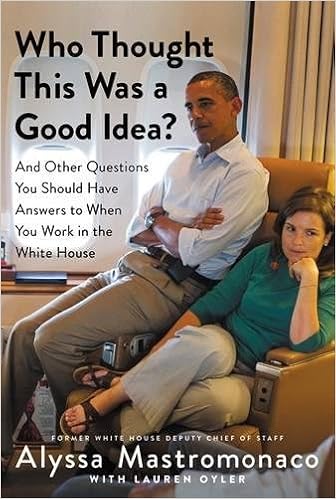
Moving on, we come to Who Thought This Was a Good Idea? by Alyssa Mastromonaco. She served as Obama's deputy chief of staff and while I previously had no idea what that entailed, now that I have read this book, I am amazed that anyone can actually do that job without having a heart attack. Mastromonaco managed to do it impeccably, even if she does suffer from IBS, which led to a particularly hilarious moment at Vatican City where she shook the Pope's hand while the staff around her were all gazing on in horror to see if she would poop on the Pope (seriously, her words, not mine). She was responsible for coordinating logistics and planning emergency relief for hundreds of thousands of people when Hurricane Sandy hit and was in Haiti for a week during the earthquake. She is also responsible for the White House finally getting a tampon machine in the women's bathrooms. And that seemingly simple gesture demonstrates what a no-nonsense and capable women she is. As far as I'm concerned, organizing fuel tankers and hiring $3 million dollar planes is of the same importance as getting the male-dominated White House to understand that female officials need tampons, and running through multiple levels of security to get to the CVS across the street is not a tenable solution.

Mastromonaco's book is a quick read but searingly effective, with not a single wasted word (much like the woman herself). She describes it as a guide to women who want to break into politics; she was never able to find such a book when she was younger as first of all, there's a dearth of female politicians, and secondly, male politicians write books to showcase their legacy and don't really spend any time telling you how to do the job. So this book is divided into ten sections that cover the key qualities for success: leadership, preparedness, independence, self-awareness, personal shit (because there is always personal shit, but only she is honest enough to address it), confidence, humility, risk-taking, resilience, and kindness. Look at that list - it is brilliant in itself and I want to tape it up by my desk as a personal mentorship guide to think about how I am developing those qualities every day. But thankfully, Mastromonaco does one better and actually talks about these subjects in vivid detail, offering up personal stories of various events at the White House or during Obama's campaigns that helped her learn and grow into the powerhouse she has become.

This is not some slick feel-good political memoir. Mastromonaco lays her life bare, highlighting all of her successes but also her failures, many of which she struggled to take in stride at the time. She suffered from anxiety, overwhelming stress, and she talks about how she is a crier and can't keep her emotions off her face, a fact that made me feel a thousand times better about myself. If that lady can have a good cry and then plan a multi-country trip to help determine American foreign policy, I can probably survive my job just fine. And she too had wonderful mentors who pushed her to take more challenging roles and insisted that she could do the job when she felt under-qualified. But she also calls out the overwhelmingly male-dominated meetings, and the times when she was talked down to or talked over simply because she was a young woman in the boy's club.

So what ties these two books together? Both women are exceedingly funny and unafraid to share the good, the bad, and the ugly. These books are hilarious and profound in equal measure, and while I was able to read them rapidly, I am certain I shall be re-reading them multiple times to gather up more wisdom and laugh over the more inane stories. Scovell and Mastromonaco may have been in two very different fields, but they both highlight how men dominated the rooms they worked in and why we need more women in those rooms. They are at the top of their game and it is clear that the world would have truly been a less wonderful place if they hadn't managed to get their foot in the door. They also demonstrate the importance of mentorship: both women had (and continue to have) excellent mentors who serve as sounding boards and provide sage advice on how to survive in Hollywood and politics, and in turn, they both serve as excellent mentors themselves to their fellow colleagues and up-and-comers.

This brings me to the point that struck me the most deeply about these books: the emphasis on empathy and kindness. These marvelous women place such a premium on these qualities, and that is why I have always personally believed we need more women in senior leadership roles. Women do not merely want to create a legacy and highlight their individual accomplishments - they usually want to build a team and get the job done effectively. And that is something we need to recognize and nurture as true leadership material. The tenth chapter in Mastromonaco's book focuses on kindness and it honestly made me tear up as she cited various examples of the kindness she experienced through the years in the Obama administration. It isn't sappy and female to treat people kindly - it is the human thing to do. Given the current state of our world and the neverending tales of misogyny, harassment, racism, and ignorance, these two books serve as a guide on how to be better. Be a better colleague, be a better boss, be a better human being. And I will be taking those lessons to heart. 
Thursday, May 24, 2018

Firebird & Afterite: Balletic Brilliance

I have lived in New York for 16 years. Which means that I always imagine I will have the chance to do "New York-y" things, so then procrastinate and never do. Which is why I had never seen a ballet until yesterday, when my friend Candice and I headed off to the Metropolitan Opera to indulge in the American Ballet Theatre's production of Igor Stravinsky's The Firebird, with ballerina extraordinaire Misty Copeland as the Firebird. Yeah, my introduction to the ballet was certainly as spectacular as possible.

The story of The Firebird is fairly simple. Ivan (Herman Cornejo in the performance I saw) is searching for his lost love in a creepily enchanted forest. He happens upon a flock of mythical firebirds and chases one down (Misty Copeland) - she escapes but leaves behind a feather that will summon her when he is in trouble. He then finds a group of enchanted maidens, but cannot tell if his lady love (Skylar Brandt) is among them as they are all under a spell by the evil sorcerer Kaschei (Duncan Lyle). What follows is your classic battle between good and evil, and the Firebird comes to the rescue to help Ivan kill Kaschei, break the spell, and reunite with his love.

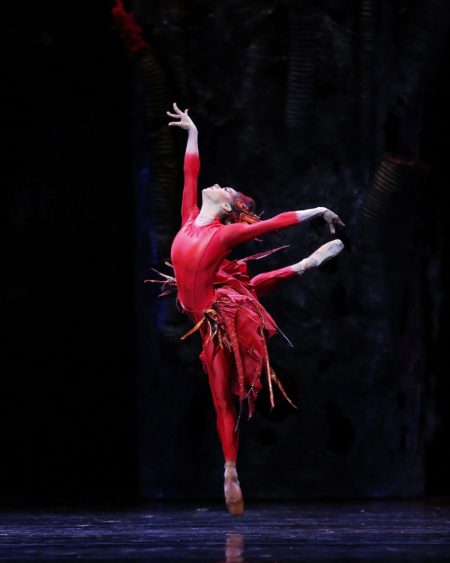
I don't know where to begin. I was so moved by this performance that I was rather appalled I had waited this long to see a ballet. While the orchestra (conducted by Charles Barker) were phenomenal, I will confess that I did not pay as much attention to the music as I expected because I was too captivated by the dancing. The grace and beauty of ballet is something I thought I understood, but it turns out watching Black Swan is insufficient to capture the power of a live performance. The choreography by Alexei Ratmansky was stunning. Combined with the costumes by Galina Solovyeva, you almost don't even need the summary of the story I provided above, because the dancers were able to capture every nuance of this tale perfectly through their movements and the feathers ruffling on their costumes. The fiery red of the Firebirds was in beautiful contrast to the green tutus sported by the pirouetting maidens, while the sorcerer's black and green swirly cape was in stark contrast to Ivan's innocent white suit.

The dancing maidens were both beautiful and funny - initially, as they are all under a spell and running around the stage following each other with exceedingly silly movements accompanied by a very amusing interlude in the music, you feel like chuckling. Skylar Brandt was magnificent as Ivan's lost love, capturing the silliness, and then moving into haunting loveliness when she meets Ivan and is drawn to him. When Duncan Lyle shows up on stage as the evil Kaschei, things take a dramatic turn, and as he controls the maidens with his invisible puppet strings, it is a sight to behold.

All of which brings me to Misty Copeland. The Firebird is her signature role, and having witnessed this performance, I have no doubts as to why. The costume was perfect, a red leotard with feathers on her head and back that let you watch her execute her dance with grace and precision, with just the right amount of fluttering feathers to make you fully believe she's about to take flight from the stage. The little hops and steps as she turns, the way she bobs her head, it was so bird-like, I was in utter awe. And of course, as she claimed the stage in jumps and pirouettes and all manner of other ballet moves that I lack the vocabulary to describe, I fully understood why she is a dancer who is celebrated across the world. There were moments when I genuinely wanted to weep and cheer, and when the entire performance was over, I felt stunned, like I had witnessed a miracle.

Following intermission, there was a very different ballet, Afterite, which had premiered on Monday. Years ago, when I was unemployed, I took an online course on classical music, and wrote my final paper on Igor Stravinsky. Part of that paper was about The Rite of Spring, a ballet that premiered in Paris in 1913 with choreography by the famed Vaslav Nijinsky, that incited a riot because it was so unexpected and unconventional and led to the composer and choreographer fleeing the theater. Well now, choreographer Wayne McGregor has created Afterite, a creepy and compelling ballet set to The Rite of Spring, with a dystopian story about the last colony of humankind. I'll confess, Candice and I (and the ladies sitting next to us) were a bit perplexed about what exactly the story was, but the choreography and music were exemplary and managed to creep us out. It was eerie, and frightening, and quite the turn from the fairytale of The Firebird, and this time, I paid attention to the music and found it utterly bewitching and bizarre when accompanied by the machinations on stage.

Firebird and Afterite are only playing at the Metropolitan Opera House through May 26. If you're in New York, I cannot urge you enough to buy a ticket and witness these thrilling ballets firsthand. But even if you don't live here, I cannot urge you enough to buy a ticket to see a ballet performance wherever you can find one. Perhaps, like me, you were laboring under the impression that this is a high-class inaccessible art form. However, it turns out, as long as you're a human being, you will find yourself transformed by the athletic grace, power, and beauty of these dancers, the ability of classical music to weave a story as it seeps into your bones, and for the choreography and costumes to come together in perfect harmony to tell a story that transcends language and time.