Thursday, July 25, 2013

Orphan Black: Attack of the Clones

From now on, no discussion of great female performances on television is complete without mentioning Tatiana Maslany in BBC America's Orphan Black. I did not watch this show when it first aired, but after reading all the rave reviews, I ended up watching the entire series in less than 24 hours. This show is incredible, all thanks to the woman at its center.

Orphan Black kicks off when Sarah Manning (Tatiana Maslany), a British con artist living in some generic North American city (the show is deliberately ambiguous about the setting), witnesses a woman named Beth Childs committing suicide at a train station. Before Beth jumps, Sarah gets a good look at her and is shocked to discover that they look identical. Sarah steals Beth's things and assumes her identity in the hopes of raiding her bank account and making a quick buck. Unfortunately, she quickly discovers that there was a reason Beth looked so much like her - they are clones.

Beth might be dead, but soon other clones start coming out of the woodwork. Beth had discovered this secret and was looking for other clones in North America and beyond. Turns out she was in touch with a few of them before her untimely death and Sarah must now reluctantly join forces with them to investigate their past and discover why anyone would have cloned them in the first place.

Maslany is acting her brains out on this show, playing several different clones who are often all in one scene together. There are scenes where three clones are talking to each other and you cannot believe that just one woman is embodying these incredibly different characters. Maslany adopts different accents and different mannerisms, and each clone is a completely independent and distinct entity from the rest. The writing on the show is also top-notch, with each show ending on a cliffhanger that keeps you coming back for more. The suspense will keep you on the edge of your seat and every episode brings twists and turns that will astonish you. But nothing is quite as astonishing as Maslany's powerhouse performance.

Orphan Black is a ridiculously entertaining show with a great premise and fantastic cast. Maslany missed out on an Emmy nomination this year, but there's no doubt that she will be sweeping up all the awards once more people start watching this show. She already won the Critic's Choice Television Award, beating out people like Claire Danes and Julianna Margulies, and I look forward to seeing what she does on subsequent seasons of Orphan Black. Bring on the clones!

Orange Is the New Black: Welcome to Prison


Women often have a better chance to portray complex and engaging characters on television than film. While summer movies have been dominated by male superheroes and incompetent grown-ups, summer television offers a welcome respite for those of us with two X chromosomes. After the success of House of Cards and Arrested Development, Netflix is continuing its hot streak with the new comedy-drama series, Orange Is the New Black, which is based on a memoir by Piper Kerman. Set in a women's prison, the first season delivers 13 episodes featuring nuanced and elegant performances from its leading ladies.

The show opens with Piper Chapman (Taylor Schilling) preparing to surrender herself to Litchfield, NY's women's federal prison. Piper is a Smith alum who currently runs an artisanal soap company with her best friend - this is not the best preparation for prison life. She has been sentenced to 15 months for transporting drug money across international borders ten years ago, which she did because she was in a relationship with a woman who worked for a drug cartel. In the first episode, Piper is introduced to the prison system and a cast of motley characters whose stories we will gradually get to know over the course of the season. Most importantly, one of her fellow inmates is Alex Vause (Laura Prepon), the woman who had Piper carting drug money all those years ago.

Although the series focuses on Piper as she navigates the prison system and deals with both real and imagined dangers, the supporting characters all have their chance to shine. Each episode weaves in the story of a fellow inmate and uses flashbacks to give us a sense of these characters and how they ended up in prison. It's very reminiscent of the flashbacks in Lost, but this show is much more tightly scripted and the writers know how to infuse these moments with insight and genuine surprise. Laverne Cox delivers an amazing performance as Sophia Burset, a transgender African-American woman who is a former fireman, while Kate Mulgrew is vastly entertaining as "Red," the Russian cook who has a tough exterior but takes care of the drug addicts who end up in the prison. The inmates' stories are endlessly fascinating and the show is careful to paint each woman in shades of grey rather than black and white. It isn't poor naive Piper against a group of hard-bitten criminals. Instead, everyone in there is a victim of circumstance or just bad luck, and they all deserve equal amounts of empathy.

The show effectively deals with the themes of sexuality and race, topics that are always brought to the forefront when dealing with prison. The prisoners divide themselves up according to race, but insist that what they're doing is "tribal, not racist." There's plenty of lesbian activity going on, but it is dealt with very matter-of-factly, and the fluidity of sexuality is constantly acknowledged. Piper's fiance, Larry (Jason Biggs), is worried that she might restart her relationship with Alex now that they're together in prison, but you'll have to watch and see if his fears are unfounded. 

Orange Is the New Black features a darkly comic narrative told by incredible actresses who are delivering performances of a lifetime. The men of the show, who play the prison guards, seem a lot more one-dimensional and predictable, but that's my only quibble. This is a show designed for binge-watching, so log on to Netflix and get acquainted with the inmates of Litchfield. 

Monday, July 22, 2013

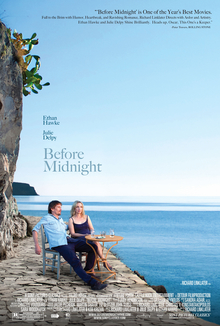
Before Midnight: The Art of Conversation

Before Midnight is the third installment in the series that began with Before Sunrise in 1995. In Before Sunrise, writer-director Richard Linklater introduced us to Jesse and Celine, played by Ethan Hawke and Julie Delpy. They meet on a train - Jesse is an American student on the last day of his European vacation, and Celine is a French student on her way back to Paris. They start talking and Jesse convinces her to get off the train in Vienna so that they can talk until the next morning when he has to catch his flight back to the States. The movie is just one long conversation between these two people as they wander through Vienna, and the next morning, as Jesse drops Celine off at the train station, they promise to meet six months from now at the same spot.

Cut to nine years later, with the release of Before Sunset in 2004. Turns out Celine never kept their date, and Jesse wrote a book about their missed connection. He's a celebrated novelist, and during a book signing in Paris, he runs into Celine again. This movie follows them through extended takes as they have a 90-minute conversation through the streets of Paris. Jesse is married now, but that spark with Celine is still there, and at the end of the movie, he's in her apartment and about to miss his flight back home.

Now, again nine years later, we have Before Midnight. And it is the perfect bookend to this incredible romance that has been unfolding over eighteen years. I don't want to give too much away because fans of this couple just have to experience their story for themselves. The bare essentials are that Jesse and Celine are still together and have kids. They live in Paris but the movie takes place during a day of their summer vacation in Greece. And again, they proceed to have a conversation that is filled with silliness, heartbreak, love, melancholy, and every human emotion in between. It's a rollercoaster ride and if you are as invested in this couple as I am at this point, you'll be on the edge of your seat, desperately hoping it all ends well. That's a hell of a thing to feel when all you're doing is watching two people talk.

After seeing this movie, I immediately re-watched Before Sunrise, and it's incredible to see how these characters have literally and figuratively transformed. But what is more incredible is how much they've stayed the same. Before Midnight echoes conversations that Jesse and Celine had during that fateful night in Vienna, and despite being grown-up parents, the two of them are still struggling with issues they had as young students in 1994. Celine is still torn between the feminist and romantic ideals, Jesse is still torn between acting like an adult or a thirteen-year old boy. It's fascinating to see how well these actors know these characters - Hawke and Delpy helped write the screenplays for both the sequels, which explains why I love them more than the original movie. Before Sunrise is a great film, but I wouldn't care for it as much if I didn't get to see where those characters ended up later in life. So much of their conversation is the sort of pretentious twaddle everyone spouts in their twenties (and the refreshing thing about these films is that the characters will actually call each other out on their pretentiousness), but what matters is the obvious connection between these people and whether their relationship will last.

Before Midnight is a riveting movie that gives these characters their due and proves yet again that a movie need not be much more than two people having a conversation. It feels like this might be the last movie, but nine years from now, if Jesse and Celine are back, I'll be ready and waiting. 

Thursday, July 18, 2013

Broadchurch: Who Killed Danny Lattimer?

Earlier this year, the UK was treated to Broadchurch, an ITV drama that immediately garnered critical acclaim and generated buzz across the nation. Starting August 7, US viewers will be treated to the show on BBC America. I suggest you set your DVRs right away.

The show is a classic whodunnit mystery set in the fictional seaside town of Broadhchurch. Detective Inspector Alec Hardy (David Tennant) has recently arrived in town after some sort of scandal over a major murder investigation elsewhere. After an 11-year old boy named Danny Lattimer is found murdered on the beach, Hardy is put in charge of the investigation. This rankles with Detective Sergeant Ellie Miller (Olivia Colman), who was passed over for promotion and doesn't trust Hardy. Miller is best friends with Danny's mother and is personally invested in finding the killer. This is her very first murder investigation - things like this just don't happen in Broadchurch - so Hardy has to school her in how things are done. At the same time, she has to teach him about this community and its various denizens, all of whom have something to hide.

Danny's parents, Mark and Beth (Andrew Buchan and Jodie Whittaker), appear to be devastated by their son's death, but it quickly becomes clear that Mark's alibi doesn't hold water. Their daughter, Chloe (Charlotte Beaumont), is also hiding something that turns up when her room is searched, which leads to further secrets and betrayals. At the same time, DS Miller's own son, who was Danny's best friend, is behaving very suspiciously and no one seems to notice. The press are also causing a stir, as is their wont, and by sleuthing around on their own they start to expose both relevant and irrelevant details. Everyone is a suspect, and as Hardy and Miller investigate the town, they turn up a series of secrets that could either be legitimate leads or red herrings.

Written by Chris Chibnall, Broadchurch is a brilliantly scripted series that keeps you on the edge of your seat and will leave you guessing until the very end. Olivia Colman and David Tennant make a fantastic team and their banter often lightens up the admittedly dark proceedings. Andrew Buchan and Jodi Whittaker  deliver dramatic performances that pack a wallop, along with every other actor in this series, all of whom are giving a hundred percent. The cinematography by Matt Gray also deserves special mention - this is a beautifully shot show and every episode looks and feels cinematic.

Broadchurch is the latest British import that is sure to have Americans talking. Thankfully a second series has already been commissioned for next year. But for now, you can look forward to eight episodes of masterful television that feature powerhouse performances and simply riveting storytelling.  

Man of Steel: Save Yourselves Because Superman Won't

The teaser trailer for Man of Steel had a lot of promise. There were beautiful shots of a young boy running around in a red cape and adopting the Superman pose by standing astride with his hands on his hips. Set to an evocative score, the final shot of Superman bursting through the clouds was thrilling and suggested that this origin story would give the iconic hero his proper due. Unfortunately, as more trailers were released, the relentless action sequences, coupled with an overpowering sense of doom and gloom, made it clear that this movie might not live up to its promise.

The movie does have a fantastic cast. Henry Cavill is the perfect embodiment of the chiseled hero (with a very creditable American accent, if you are paying any attention to that). Amy Adams is wonderful as intrepid journalist, Lois Lane, who discovers Superman's identity early on in the movie and has a lot more to contribute in terms of brains and brawn than most incarnations of this character. Russell Crowe shows up as Jor-El, Superman's biological father from the planet of Krypton, while Kevin Costner and Diane Lane are nice and normal as his human parents, Jonathan and Martha Kent. So the moviemakers have all the right players, just not the right story.

The first half is reminiscent of the teaser trailer - we see flashbacks of young Clark as he discovers his powers, and how his father urges him to keep them hidden lest he become an object of government scrutiny. We see him wander around America, engaging in anonymous feats of heroism, all whilst attempting to discover his true identity. This is compelling stuff and a refreshing take on an age-old story. Unfortunately, the second half devolves into a complete audiovisual assault on the senses. The villain of the piece, General Zod (played by a scenery-chewing Michael Shannon), arrives on Earth and enacts his vengeance upon Superman's adopted planet, which reduces half of Metropolis to a mass of smoking rubble. The amount of wanton destruction is simply obscene and Superman himself seems to destroy a lot of the city just by being thrown around by villains. There are numerous action sequences where the main point seems to be, "let's see how many more buildings we can destroy, body count be damned!" The whole point about being a superhero is that you must save people, yet Superman spends most of the movie off on a solo mission well away from all the humans he's supposed to protect. All this while a relentless Hans Zimmer score blares in your ears and makes you wonder how much more of this pointless movie you have to endure.

The first hour and final ten minutes of Man of Steel set up the classic Superman story in a delightful new way. Unfortunately, the middle is just an inexcusable morass of death and destruction. Of course, a sequel is already in the works, and all I can say is that it had better have a lighter tone, less clunky dialogue, and a lower body count. The filmmakers needs to focus on the characters and relationships that are at the heart of this story. The movie is called Man of Steel - shouldn't it be more about Superman?

Saturday, July 13, 2013

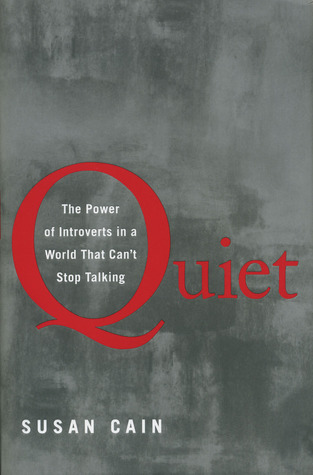
Quiet: Revenge of the Introverts

Susan Cain's 2012 book, Quiet: The Power of Introverts in a World That Can't Stop Talking, has won widespread acclaim and earned a place on many bestseller lists. Hardly surprising since her target demographic loves nothing more that to curl up with a good book. Over the course of 300 pages, Cain discusses the rise of the "extrovert ideal" in Western culture (more precisely American culture), and how this greatly undervalues the contribution of society's introverts.

Cain uses biological and psychological research to explain what makes someone an introvert. Surprisingly, it appears to be programmed into us from birth, with some babies being far more reactive to outside stimulation than others. These "high-reactives" go on to become introverts, people who get a little too affected by the world around them and therefore need to take a break from it once in a while. This is in contrast to their "low-reactive" counterparts who can't get enough stimulation and thrive in lively environments.

There's nothing wrong with being an introvert - it's just another way of being. Unfortunately, American culture has marginalized introversion and from a young age, children are made to feel as though they are doing something wrong if they don't talk more or socialize constantly. Classrooms are organized to encourage group activities and discussion, which may not even be the best way to instruct children, but has been deemed superior by the American educational system. In fact, a particularly humorous chapter discusses Asian students who moved to America and were instantly shocked at the way classrooms operated. One woman says that she was quiet and therefore regarded as less intelligent, while other students would just start talking, saying nothing of any real substance but still receiving high marks for "class participation." Introverts have great ideas and are often incredibly creative problem-solvers, but their reluctance to speak up means that they are often ignored in the group settings that dominate classrooms and businesses across America.

Study after study has shown that the "groupthink" and enforced teamwork that Western businesses encourage, are often completely counterproductive and result in fewer ideas of poorer quality. Yet, open-plan offices continue to be the norm and people are forced to work in teams when they may be far more productive on their own. Extroverted business leaders were probably responsible for the financial meltdown of 2008 because they were more prone to reckless actions when an introvert may have taken the time to stop and think. Harvard Business School is a bastion of extroversion, churning out extroverted business leaders year after year who may not fully appreciate and utilize the thoughts and actions of their introverted colleagues. Cain offers multiple examples of introverts who have succeeded in life by virtue of their temperament, and illustrates that introversion is something that Western society has demeaned for far too long.

Quiet is a wonderful book for introverts who feel underappreciated, but it is equally relevant to extroverts who want to understand the introverts in their lives. Cain offers advice for teachers, employers, and parents, and explains what it takes to cultivate and harness the powers of introversion. Extroverts need introverts and vice versa, and we need to find a way to bring the yin and yang together to create a more harmonious society.

Thursday, July 11, 2013

Not Going Out: Stay In and Have a Laugh

Lee Mack first came to my attention as one of the team captains on Would I Lie To You? On that show he is always ready with one-liners and self-deprecating jokes about being from the North. Therefore, it is no surprise that his long-running BBC sitcom, Not Going Out, is a rapid-fire assault of jokes and farcical situations that provide a hysterical half hour of comedy.

In the show, Lee is a Northern layabout who shares a flat with Kate (Megan Dodds), an American girl who is the ex-girlfriend of his best friend Tim (Tim Vine). Megan Dodds left the show after one season and was replaced by Sally Bretton, who plays Tim's sister, Lucy. Lucy buys the flat and becomes Lee's landlady, so she has to continually hector Lee to get a job so that he can cough up some rent money. Of course, Lee and Lucy have a great deal of will-they-or-won't-they chemistry, which frustratingly has yet to be resolved. Lucy has had a string of boyfriends, while Lee has gone on a series of horrendous dates in true sitcom fashion. The lovely Miranda Hart also starred in the second and third season as Barbara, the world's worst cleaning lady, who mainly serves to egg on Lee's pursuit of Lucy and mock him mercilessly when his plans fall through. Katy Wix plays Daisy, Tim's incredibly dense girlfriend, who always gets on Lee's nerves and has a penchant for making a bad situation even worse.

Shot in front of a live studio audience, Not Going Out is a very traditional sitcom that often follows many predictable sitcom tropes. What makes it wonderful to watch, however, is the density of jokes crammed into every episode, and the barrage of comedic banter that ensues as the characters deal with inane complications that only exist in the realm of TV comedy. The cast are all wonderful, particularly Lee Mack who both mocks and is mocked fearlessly in each episode. His relationship with the much more middle-class Tim and Lucy is a source of constant amusement, and many episodes make you burst out laughing as they escalate into utter pandemonium.

Not Going Out just finished its sixth season and is still going strong. You can watch for the laughs, stay for the simmering Lucy-Lee chemistry, and just enjoy the comfort of a cozy British comedy. It's nothing groundbreaking, but it certainly is consistently funny, and that's more than you can say for most sitcoms.