Thursday, January 30, 2014

August: Osage County: A Truly Dysfunctional Family

I went into August: Osage County with exceedingly low expectations. I came out pleasantly surprised. Perhaps it helped that I knew nothing about the story of this Pulitzer-winning play. As a result, I was treated to two hours of a genuinely surprising, oftentimes hilarious story anchored by strong, powerful performances from some of the greatest actresses of our generation.

I won't discuss the plot of this movie/play extensively because you either know it or you don't; and if you don't, you're in for a treat. In essence, Meryl Streep plays Violet, the matriarch of the Weston family, who are all gathered together at the family home in Oklahoma during a crisis. In the ensuing days, family secrets bubble to the surface, animosities and resentments are flung about (along with some of the crockery), and the aftermath is alternately hilarious and depressing, entertaining and frustrating.

The cast is a who's who of famous faces that ensures you will never again flounder at a game of Six Degrees of Separation. The daughters of the Weston clan are played by Julia Roberts, Juliette Lewis, and Julianne Nicholson, an actress I have become particularly fond of after her remarkable work in Masters of Sex. Roberts is in fine form in this film, going toe-to-toe with Meryl Streep and flinging f-bombs with aplomb. Her husband is played by an initially unrecognizable Ewan McGregor, and their fourteen-year old daughter is played by Abigail Breslin, who gets into her fair share of trouble as the movie progresses. Margo Martindale is wonderful as Mattie Fae, Violet's sister who harbors a deep secret that you won't see coming. Chris Cooper plays her husband Charlie, who opens an infamous lunch scene by delivering a grace that made me laugh out loud, while Benedict Cumberbatch is utterly charming (complete with Southern accent) as her disappointing son, "Little" Charles.

This is an incredible story about family dysfunction, told with the blackest of humor. The screenwriter is the original playwright, Tracy Letts, and like with any play, the dialogue can get pedantic. But once the women are back to swearing at each other, things are on an even keel. I initially thought the award nominations for Roberts and Streep were mere kowtows to Hollywood royalty, but after watching this movie, I have absolutely no objections. These are some incredible performances that I won't forget in a hurry, and despite the dark subject matter, I truly enjoyed this movie. Every character feels real and fleshed out, and at just two hours, this is a shockingly zippy film. So watch August: Osage County - it is chock-full of dysfunctional surprises.

Tuesday, January 28, 2014

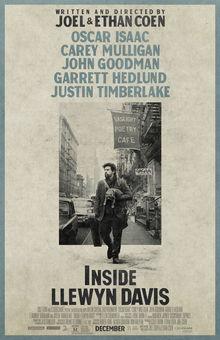
Inside Llewyn Davis: Making Music in Manhattan

I love the Coen brothers, so I expected to love their latest film, Inside Llewyn Davis. Instead, I can only say I liked it, though the soundtrack (produced by the divine T-Bone Burnett with input from Marcus Mumford) will stay with me forever. And perhaps that's the point - this is a movie about folk music, where the songs live on through the generations, while the singers and their stories mostly fade away from memory.

At the center of the film is, of course, Llewyn Davis, a struggling musician loosely modeled after real-life folk musician Dave Van Ronk. Oscar Isaac plays Davis, in a flawless performance that would have won multiple accolades in any other year but has sadly been eclipsed this year by a glut of Oscar-worthy performances. The movie opens with a haunting rendition of Hang Me, Oh Hang Me in a smoky cafe, with nothing but Isaac's voice and guitar performing live, as are all the other performances in this movie. It is a perfect introduction to this film that beautifully captures the wintry look and feel of Greenwich Village in 1961 and the burgeoning folk music scene.

Llewyn hasn't found his big break, and for one week, this movie follows him from performance to performance, as he sleeps on friends' couches and grows increasingly disenchanted with the life he has chosen. This character reminded me immediately of Larry Gopnik in another Coen brothers film, A Serious Man. Like Larry, Llewyn has trials and tribulations heaped upon him in unforgiving quantities. Every time he chooses a path, you feel an ominous sense of dread that he has yet again made the wrong decision. It is a testament to my eternal cinematic optimism that at one point in this film, I genuinely thought Davis had finally made it. Sadly, I was mistaken.

The supporting cast includes Justin Timberlake and Carey Mulligan as folk duo, Jim and Jean, as well as Adam Driver, John Goodman, Garrett Hedlund, and others who sail in and out of Llewyn's life. Inside Llewyn Davis feels more like a series of sketches, a dark catalog of failures that amounts to nothing much at the end. Perhaps what rankles most is that the music is so wonderful and Llewyn's songs are so moving that you can't understand why he isn't more successful. Sadly, that's the price of being an artist; talent is so rarely rewarded. The Coen brothers have escaped that fate, but Llewyn Davis does not. 

Sunday, January 26, 2014

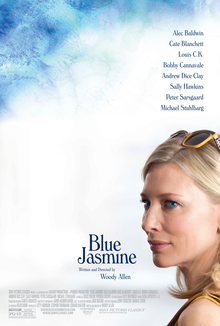
Blue Jasmine: A Woman on the Verge of Something

I can't claim to be a Woody Allen devotee but ever since he left New York behind to shoot movies in other locales, I've found myself far more engaged in his work. Heresy, I know. Blue Jasmine is set in San Francisco, with flashbacks about Jasmine's old life in New York. However, this is an Allen film where the location doesn't really matter. Instead, the focus is squarely on Jasmine.

Played by Cate Blanchett (who is almost a lock for the Best Actress Oscar this year), Jasmine Francis arrives in San Francisco to live with her adopted sister, Ginger (the wonderful Sally Hawkins). Jasmine was a glittery Manhattan socialite, married to Hal (the reliable Alec Baldwin), a wealthy businessman whose empire came crashing down when he was arrested for fraud. Jasmine is now completely broke, suffering from acute mental distress, and has arrived at Ginger's doorstep to get back on her feet. The sisters aren't especially closetheir lives diverged widely and Jasmine was too self-absorbed to have much time for her working-class sisterbut Ginger is a kind woman who wouldn't dream of abandoning Jasmine in her time of need.

Blanchett's performance is a dream to watch. At first, Jasmine seems like a woman to root for, someone who has suffered a great deal and requires the audience's sympathy despite her penchant for histrionics. However, more is gradually revealed about her past and her extremely flawed personality. Rather than being the heroine, she's revealed to be the villain, a woman who has failed spectacularly and dragged everyone down with her. And yet, she remains oblivious, convinced that she is a victim of fate who has no personal responsibility for her downfall.

The supporting cast is filled with several well-known actors, including Bobby Canavale as Ginger's stereotypical working-class boyfriend, Chili, and Louis C.K. as a rival for Ginger's affections. Peter Sarsgaard puts in a very un-Sarsgaardian appearance as a wealthy man who might be the answer to Jasmine's troubles, and their relationship winds along merrily to its inevitable conclusion. But everyone pales in comparison to Blanchett, whose trembly, arrogant performance steals every scene. As much as you hate Jasmine, you can't help but feel a sneaking admiration for her steely resolve and selfishness. Despite her many troubles, this is a wily woman, and you keep wondering if Jasmine will claw her way back to the top.

Woody Allen has clearly modeled Jasmine Francis after another flawed and fallen woman, Blanche DuBois from A Streetcar Named Desire. She is a complicated, frustrating, fascinating character and a wonder to behold throughout this movie. The various subplots and shenanigans of Blue Jasmine are less than memorable, but Jasmine is a woman you will never forget. The next time you hear the familiar strains of Blue Moon, you'll say to yourself, "Oh, I remember this was playing when I first saw Jasmine..."

Saturday, January 25, 2014

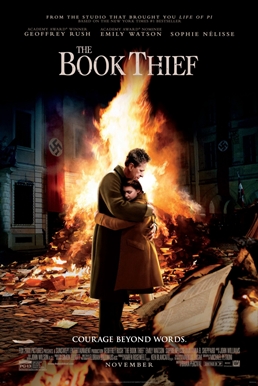
The Book Thief: Literary Larceny in Nazi Germany

I recently read Marcus Zusak's The Book Thief, an absorbing story about a young girl in Germany on the brink of World War II. She is adopted by foster parents who teach her to read using books she steals in strange and often tragic situations. Narrated by Death, this is an initially odd and ultimately moving tale about a brave family that shelters a Jewish man and the various tragedies they experience alongside the small joys of their ordinary lives. The book is a sprawling 560 pages, but now it has been condensed into a two-hour movie. It's a serviceable effort, but fails to capture the much-needed nuance and delicacy of the novel.

Sophie Nélisse puts in an astonishing performance as twelve-year old Liesel Meminger. Liesel is a mere child who has to grow up quickly as she learns of the horrors of Nazi Germany. Nélisse's face captures every shifting mood and emotion that the young girl experiences over the course of the film, tumbling from joy to despair with credible ease. Her foster father, the kind and charming house painter Hans Hubermann, who teaches Liesel to read every night, is played by an incredibly warm Geoffrey Rush. Emily Watson plays his wife Rosa, a foul-mouthed woman with a heart of pure gold. Oftentimes, the movie fails to do this character justice because all you get is her outer coarseness and not enough of her inner warmth.

Ben Schnetzer plays Max Vandenburg, a Jewish man whose father fought alongside Hans in World War I. When he arrives at the Hubermann's doorstep, they do not hesitate to give him shelter from the Nazis. Max and Liesel have a wonderful connection - he's stuck in the basement all day so he relies on Liesel's daily descriptions of the world outside. In return, he writes her short fables and stories to help with her reading. Of course, these relatively idyllic conditions cannot persist and the Hubermanns have to face a perilous reality as World War II gets into full swing.

The Book Thief features a great cast and wonderful production design. The only trouble is that the script cannot capture all the subtlety and complexity that makes this story so compelling. It feels a bit clinical, a little too neatly told, rather than the oftentimes messy and tangential narrative of the novel. It's the opposite problem of The Secret Life of Walter Mitty, where the writer had expanded a short story to a long movie. Here the screenwriter, Michael Petroni, has turned a long book into a short movie, and it doesn't entirely work. This is by no means a bad movie, but it isn't a great one. If you refuse to read the book, you could perhaps get away with watching the movie, but you would be missing out on a truly engrossing tale.

Thursday, January 23, 2014

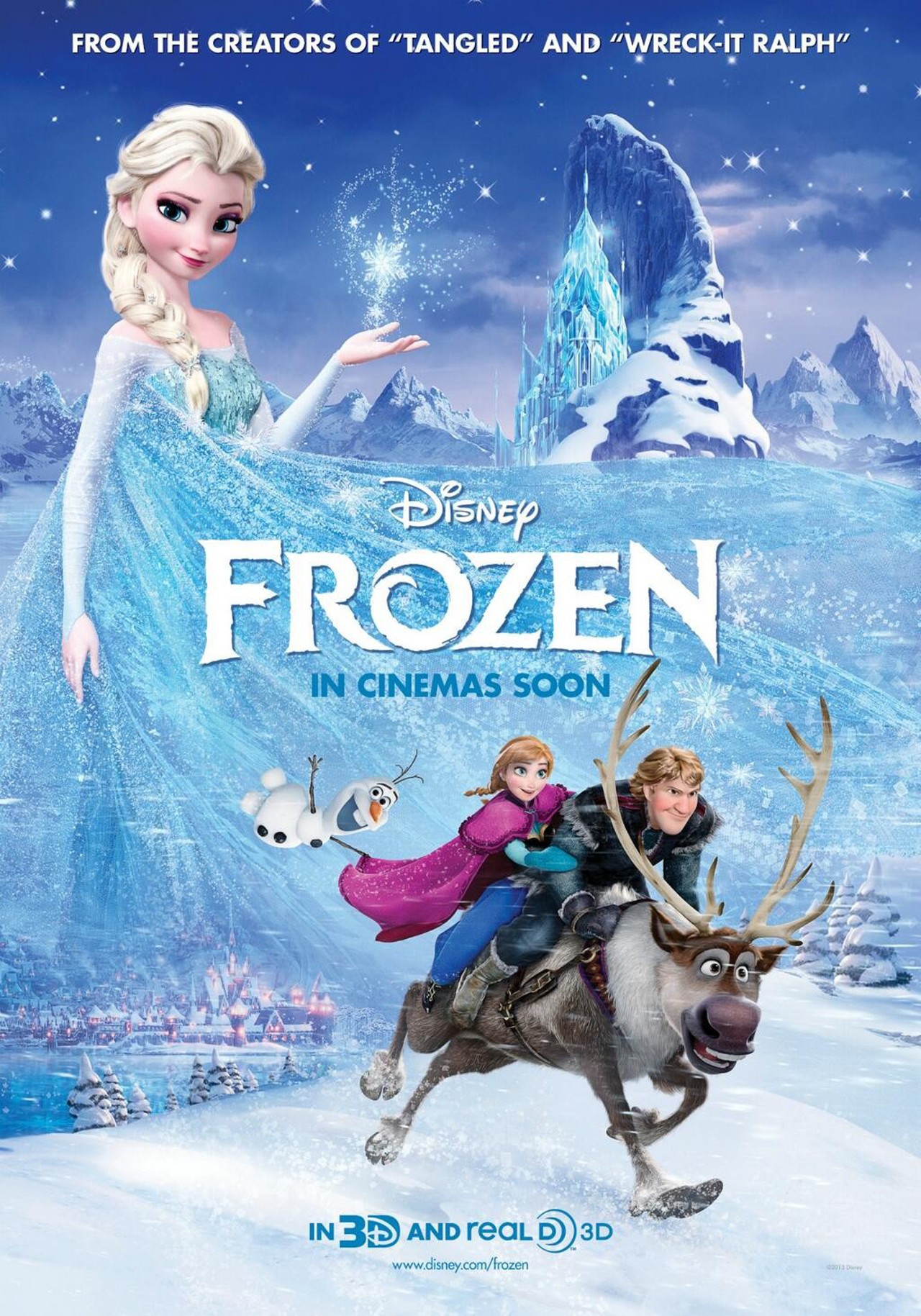
Frozen: Disney Princesses Learn a New Lesson

The first thing you need to know about Frozen, Disney's latest animated princess movie, is that it was written and co-directed by a woman, Jennifer Lee. Thanks to her perspective, Disney has finally produced a movie with princesses who discover that "true love" doesn't always require a handsome prince.

Frozen tells the tale of two princesses in the kingdom of Arendelle, Anna and Elsa (voiced by the amazing duo of Kristen Bell and Idina Menzel). Elsa is born with the magical ability to create snow and ice, a skill she uses to make snowmen and create a winter wonderland whenever Anna demands. However a terrible accident leads to Anna being frozen by Elsa's powers. Her parents rush her to a group of trolls who are able to reverse the magic and remove all of Anna's memories about the incident and Elsa's powers. From that moment on, Elsa is too terrified to play with Anna and her parents decide it is best to keep her isolated in the castle as she tries to control her ever-growing powers.

A few years later, it is time for Elsa's coronation and the kingdom's gates are opened for the first time in years for the festivities. Unfortunately, Anna and Elsa get into a serious argument, causing Elsa to lose control and freeze everything around her. Unable to stop, Elsa flees from the castle into the mountains, but not before Arendelle has been enveloped in a perpetual winter. What follows is Anna's quest to find her sister and reverse the wintry conditions. On the way she meets various sidekicks who help her trace Elsa's whereabouts. A series of misfortunes suggest that both sisters might meet a tragic end. But there's a wonderful twist, where the people who would traditionally come to the rescue are revealed to be useless, while the princesses are in charge of their own fate. It's a witty, slyly subversive take on classic Disney tales, and ultimately a surprising and heartwarming story.

Frozen features impeccable animation, with a blend of hand-drawn and CGI imagery that will leave you shivering in your seat. It is highly inventive and features a haunting score inspired by native Scandinavian music. The soundtrack is composed by Christophe Beck (composer for the scintillating Paperman) and the movie opens with a traditional Sami song, which will instantly transport you into this world. The voice acting is excellent (Josh Gad as a silly snowman is particularly hilarious) and Kristen Bell and Idina Menzel are marvelous singers. The songs written by Robert Lopez and Kristin Anderson-Lopez are hilarious and inspiring, giving the audience the full Disney experience.

Like Brave, Frozen highlights a new trend of giving young girls better female role models who are less concerned with finding a boyfriend and spend more time focusing on the importance of family and becoming your own person. It's still a princess movie, but it's another step in the right direction and I can't wait to see what Disney gives us next.

Monday, January 20, 2014

The Secret Life Of Walter Mitty: A Simple Epic

The Secret Life of Walter Mitty was a short story by James Thurber, published in the New Yorker in 1939. A simple tale about an ordinary man who likes to daydream about being in extraordinary situations, it takes all of ten minutes to read. And yet, director Ben Stiller has turned this short story into a two-hour spectacle, filled with comedy, wistfulness, and epic splendor.

Stiller plays the eponymous Walter Mitty, who in this movie is a negatives assets manager for Life magazine, which is about to publish its very last print copy. Walter has a special connection with one of Life's photographers, Sean O'Connell (Sean Penn), a man he has never met, but whose work he admires. Sean sends Walter some negatives and claims that #25 should be on the cover of Life's final issue. The new bosses (including an ominously-bearded bully, Ted Hendricks, played by Adam Scott), are eager to see #25, but there's just one problem. It's missing.

In the meantime, Walter is also trepidatiously wooing Cheryl (Kristen Wiig), a woman who recently joined the magazine and caught his fancy. He can't seem to speak to her though, so he resorts to creating an eHarmony profile to send her a "wink." However, his attempts at online romance are foiled because his profile is completely blank - he hasn't been anywhere or done anything noteworthy. The eHarmony customer representative (delightfully voiced by Patton Oswalt) is bemused by Walter's tame existence and it doesn't look like our hero will ever figure out how to get the girl. However, in a rapid turn of events, Walter decides to hunt down negative #25 and embarks on a journey that takes him from Greenland to Iceland to the Himalayas. Not bad for a man whose previous notable trip was a layover at the Colorado airport.

The soundtrack (composed by Theodore Shapiro with contributions from the fantastic Jose Gonzalez) and music is uplifting and beautiful. The cinematography is spectacular and the locations are breathtaking. As Walter climbs snowy mountains and dives into oceans, you can tell Stiller went all out to inspire a sense of awe. Back in New York, his chemistry with Wiig is charming, as are his interactions with Shirley Maclaine and Kathryn Hahn, who play his mother and sister. This movie is a gorgeous visual treat, whether you're gazing at an Icelandic panorama or suddenly salivating over a slice of Mrs. Mitty's clementine cake.

However, as grandiose as it is on a cinematic scale, The Secret Life of Walter Mitty is a very slight movie in terms of story. Which is to be expected, since the original tale was just about a man driving around New York with his wife and daydreaming. There are moments when the movie feels indulgent and the story is being stretched thin. It doesn't neatly fit into any genre, sometimes leaning towards epic fable, other times to romantic comedy. But all the threads come together at the end and I wasn't bored for an instant. This is a charming tale, ambitiously told, and like Walter Mitty, it may not be perfect, but it's certainly endearing.

Thursday, January 16, 2014

Books, Movies, Rhythm, Blues: Nick Hornby Discusses the Finer Things

The great thing about an essay collection is that it's easy to read when you're on the go. You can quickly read one essay on the bus, scan another at your desk between meetings, catch up on a few before bed. Unfortunately, if the writer happens to be Nick Hornby, you'll be so delighted with the tales he has to tell that you'll just read the entire collection from cover to cover in one sitting.

Books, Movies, Rhythm, Blues is a 2013 e-book that collects some of Hornby's best non-fiction pieces over the years. You can read collections of his brilliant "Stuff I've Been Reading" columns he wrote for the Believer (I read More Baths Less Talking recently and highly recommend it if you want intelligent and humorous commentary on literature and life, as well as a stack of book recommendations), but this collection spans more than just books. It includes musings on music, filmmaking, sports, and highly amusing autobiographical anecdotes. There's much to love here, and each reader will find their own favorite piece, so I'll just highlight some of my favorites. 

Naturally the essay about P.G. Wodehouse was a corker (I made my dad read it the instant I was finished). Hornby perfectly captures why we love Wodehouse - the complexity of language, the intricate plots, the chance to just unwind and enjoy the image of a daffy Earl doting on his prized pig. Hornby's essay about the process of adapting and making the movie, An Education (for which he received a Best Adapted Screenplay Oscar nomination), is a wonderful insight into the creative process and the challenges of screenwriting, producing, casting, schmoozing, and traipsing around film festivals. You'll want to re-watch the movie as soon as you're done reading about how it made the journey from his pen to theatres. If TV's your thing, there's an excellent essay about The West Wing, that serves as a loving ode to the show in particular, and a comparative critique of the merits of American and British TV in general. At the time of writing, Hornby seems to despair of British TV, contending that it has been beaten by the burgeoning quality of American television. I wonder what he would say today.

However, the essay that made me laugh loudest was a hysterical tale about Hornby's part-time job at the English branch of some well-known South Korean corporation. He started out as a weekend English tutor to help the Korean salesmen but slowly finagled a job that would let him work in the afternoon and write in the mornings. This supposedly cushy job quickly devolved into a series of weird scenarios where Hornby was subjects to the caprices of the company's South Korean chairman, who would announce in Seoul that he wanted to re-create Hampton Court or purchase an equestrian center to train the Olympic equestrian team, and these lofty demands would be filtered down to Hornby, who would have to research their practicality. A complete wastrel at heart, Hornby was astonished at how seriously his colleagues took these requests, requiring that equestrian centers be purchased within a week instead of waiting six months and forgetting all about it as he envisioned. It's a wonderful clash of cultures, work ethics, and personalities, and guaranteed to make you burst out laughing. 

As you may have noticed, I haven't singled out any music-related essays. Hornby is a music fanatic (this is the man who wrote High Fidelity after all) and his music essays are written with obsessive love. Unfortunately, music journalism is not my thing and I tended to skim those pieces. But if you love articulate, passionate critiques about songs, artists, and decades of musical change, you'll love what Hornby has to say. Books, Movies, Rhythm, Blues has enough material to whet the appetite of any reader, regardless of your interests. Some essays may be more relevant to you than others, but they are all equally insightful and hilarious.