Wednesday, January 7, 2015

Foxcatcher: Deeply Disturbing Drama

Foxcatcher was widely praised at the Cannes Film Festival last year, earning Bennett Miller the Best Director award. Steve Carell received a great deal of kudos for his portrayal of the immensely bizarre and enigmatic John E. du Pont, a dramatic turn that is a complete departure from anything you've ever seen him in. Mark Ruffalo and Channing Tatum are equally magnificent as Dave and Mark Schultz, the brothers who won gold medals at the 1984 Olympics and came to du Pont's attention when he decided to start a wrestling team. Based on actual events, Foxcatcher tells a deeply weird and unsettling story, but the way in which it is told may undermine your actual enjoyment of the movie.

The movie opens with Mark Schultz, shortly after his Olympic win. Mark is dedicated to the sport of wrestling, but he isn't a great public speaker or natural-born leader like his much more charismatic brother, Dave. Mark is struggling to support himself, and his dream to win another gold at the 1988 Seoul Olympics seems impossible. Enter John E. du Pont, heir to the Du Pont family fortune and more eccentric than any fictional millionaire you've seen. Du Pont doesn't know anything about wrestling but has inexplicably decided he wants to become a wrestling coach and lead Team USA to victory at the World Championships and Olympics. He woos Mark to come live on his sprawling Foxcatcher Farm estate and start training a team at the wrestling facility he has established there. Flattered by the attention, Mark tries to establish himself as a successful trainer. Unfortunately, he is just not as capable as his brother, and under du Pont's dubious guidance, things quickly take a turn for the worse.

You may or may not know how this story ends. I had some idea, though not the precise details, so I spent two hours waiting to see the thing happen that I vaguely knew would happen and in the meantime wondering what on earth was actually happening on screen. Foxcatcher is mainly a psychological drama that tries to get inside these characters' heads and find an explanation for the abrupt occurrence at the very end. But the more it tries to make sense of these people, the more unclear their motivations become. Du Pont has mommy issues, megalomania, and a coke habit; Mark is impressionable, jealous of his older brother, and losing his way. Du Pont has money but he has no skill, while Mark is struggling to make money off his one great talent. Dave is the "normal" one, with a wife and kids, a good job, and a passion for his sport, which makes it all the more tragic when he gets recruited into the crazy world of Team Foxcatcher.

I didn't think I liked this movie when I saw it, but upon reflection, it is actually quite fascinating. The story beats drag on a bit, but the film presents some brilliant character studies and the actors are all doing some of their best work to date. The score is eerily perfect, raising goosebumps at various moments and reminding you that this is not a happy tale about achieving the American dream but instead a look at how that dream can go horribly wrong. I would have preferred a shorter movie, but then maybe it wouldn't have afforded me enough insight (or lack thereof) into these characters and their twisted psyches. Ultimately, we can never really understand these men, but Foxcatcher is an intriguing attempt to deconstruct them and present their disturbing story. 

Monday, January 5, 2015

Pride: Joyful and Uplifting

Pride is based on a very strange and wonderful true story out of 1980s Britain. A group of gay and lesbian activists decided to raise money to support Welsh miners who were striking to protest the harsh policies of the Thatcher-led Conservative government. The LGBT community had suffered a great deal under the Conservative opposition to gay rights, so they sympathized with the miners' struggles and thought it was only right to support their fellow sufferers under Tory rule. As you can imagine, miners aren't the most gay-friendly people on the planet but Pride outlines how these two very different communities united behind a common cause and developed a rather beautiful friendship.

The cast of characters includes Mark Ashton (Ben Schnetzer), the outspoken gay man who comes up with the idea of creating LGSM (Lesbians and Gays Support the Miners); his friend, Mike Jackson (Joe Gilgun) who supports him when everyone else thinks it's an insane idea; Gethin Roberts (Andrew Scott) who runs the gay bookshop that LGSM operates out of; his partner, Jonathan Blake, a flamboyant actor (Dominic West, as you've never seen him before, in a simply sublime role); the young Joe Copper (George MacKay) who is not out to his parents but inadvertently becomes a part of LGSM and is cautiously finding his foothold in the gay community; and the one lesbian, Steph Chambers (Faye Marsay), though a few more do join the group later on. Together, they represent quite a range in terms of life experience and level of self-acceptance, but they become a close-knit family as they strive to make LGSM a success.

Initially unable to find a miner's union that will accept money from an LGBT group, they cold-call the tiny Welsh mining village of Onllwyn and become allied with this remote community. Paddy Considine plays Dai Donovan, the leader of the striking miners in Onllwyn, and after getting over the surprise that these donations are coming from a group of gay people, he quickly proves himself to be a faithful ally to his new friends. He and Mark believe in the same philosophy that people need to put aside their differences and support each other for the common good, and he is fully grateful for LGSM's aid. But when Dai and his Committee members invite LGSM to their village to thank them for their support, there is of course plenty of controversy. The more conservative members of the village are pitted against the more empathetic folk who make up the Committee, and things get off to a shaky start. However, after a rousing evening of disco dancing and general camaraderie, the villagers start to wonder if these gays and lesbians might not be so bad after all. The movie is by no means looking at the world through rose-colored glasses: there is plenty of opposition, prejudice, and heartbreaking pigheadedness to endure; yet it somehow retains a constantly uplifting and joyous tone, a promise of the changes to come and the gradual dawning of a new day for both the mining unions and the LGBT community.

Writer Stephen Beresford and director Matthew Warchus have put together a stunning movie about the ability of people to empathize and evolve to love and support their fellow humans. The Onllwyn Committee members are played by British stalwarts like Bill Nighy and Imelda Staunton, and they all do a wonderful job of portraying how different people can approach the topic of gayness with clumsy kindness and eventual acceptance. Some elements of the story are more predictable than others, and a fair amount of cinematic liberties are taken to dramatize key moments. Yet I was astonished and thrilled to learn how much of this story was actually true.

Pride is a truly triumphant tale, all the more impressive because it never gets too sanctimonious or treacly. It doesn't hide the dangers the LGSM members faced against the rampant homophobia prevalent at the time, but it shows how much they still managed to achieve through sheer force of will and goodness. We definitely need more stories like this.

Tuesday, December 30, 2014

Into the Woods: The Perils of Happily Ever After

After watching Into the Woods, I have been humming the songs non-stop. Given the twisty deviousness of Stephen Sondheim's lyrics, I am as yet incapable of actually singing the songs, but that will be my New Year's resolution. I downloaded the entire soundtrack and I believe if you just listened to it, you would barely miss a beat of the plot. The entire movie consists of talk-singing and is simply one of the most splendid spectacles you could witness in a theater this winter.

Into the Woods features an all-star cast, who, unlike the cast of Annie, are actually all good singers. The only disappointment in the bunch is Johnny Depp, in a woefully misguided bit of stunt casting as The Wolf. Thankfully, he only has one song before he is quickly dispatched. James Corden and Emily Blunt are unsurprisingly delightful as the Baker and his wife, the childless pair who have to set off on a scavenger hunt to retrieve items for the Witch (Meryl Streep) who lives next door. The items they seek will be found in the woods, where they will run into four well-known fairy tale characters: Cinderella (a simply marvelous Anna Kendrick, who is proving that her Tony nomination at the age of 12 was no fluke); Jack, of Jack and the Beanstalk fame (Daniel Huttlestone); Little Red Riding Hood (Lilla Crawford), and Rapunzel (MacKenzie Mauzy).

Every actor is bringing their A game (the young ones are particularly talented, singing effortlessly and giving the veterans a run for their money) and they throw a wealth of expression into every song, bringing out humor and gravitas, fear and romance, and every emotion in between. I was going to enumerate which of the songs stood out in particular for me, but quickly realized I was just going to name all of them. There is such a variety of emotion and skill on display, from the hilariously hammed-up rendition of "Agony" by Chris Pine and Billy Magnussen as the two ridiculous Princes in love with Cinderella and Rapunzel, to the heartwrenching "Stay With Me" by Meryl Streep, who just knocks it out of the park. Each song is a mini-story in its own right, and even if this wasn't the most tightly-plotted tale I've ever seen, I wouldn't care because I could just listen to those songs all day.

The first act of Into the Woods is a fairly traditional telling of these fairy tales, where every character gets their happy ending. But Act 2 follows up on what happens after "Happily Ever After" and becomes a truly grim affair. I've never seen the stage version, but having read a plot summary, the movie is certainly somewhat Disney-fied: there are fewer deaths, certain narrative devices have been dropped for the sake of cinematic clarity, and several songs were cut for time. And yet, screenwriter James Lapine, who wrote the book for the original musical, has done a beautiful job of translating this tale to screen and bringing it to a wider audience. Director Rob Marshall, the man responsible for the modern revival of movie musicals, is the ideal person to wrangle together this enormous cast and tell this larger-than-life story. The costumes are wonderful, the special effects are grand, the cast is perfect, the music is impeccable, and the woods are spectacular, alternately imbuing the movie with darkness and light as the plot demands.

Into the Woods is a beloved musical and this cinematic adaptation is a triumphant showcase of the genius of Stephen Sondheim's music and lyrics. The settings and visuals are sumptuous, adding a dimension that you can't get from a simple stage production. This is a lovingly and cleverly crafted piece of art: you could wish for nothing else. 

Monday, December 29, 2014

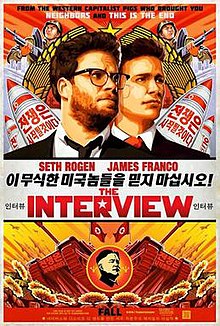
The Interview: A Competent Comic Caper

I'm not sure if posting a review of The Interview will single me out for a North Korean hack. And yet, having watched this movie, I fail to understand what all the fuss was about. This is a perfectly run-of-the-mill Seth Rogen/James Franco comedy. Goofy, filthy, funny, and dumb. Yes, Kim Jong-Un is a character, but he isn't even vilified as he should be: he just comes off as a somewhat childish despot, who likes listening to Katy Perry and drinking margaritas. Hardly cause for political uproar.

Franco plays Dave Skylark, host of a celebrity talk show, and Rogen plays his producer, Aaron, who starts to wish they could cover more meaningful news. Upon discovering that Kim Jong-un (played by Randall Park) is a big fan of Skylark Tonight, he decides to score an interview with the North Korean dictator. The North Koreans agree, but then CIA Agent Lacey (the delightful Lizzy Caplan) arrives and asks Dave and Aaron to assist in the assassination of Kim Jong-un. Cue lots of jokes about American interference and past CIA mistakes. As much as the movie talks about the brutal North Korean regime, it pays equal attention to America's political atrocities at home and abroad and serves up some meaningful political commentary. All of which is largely buried under sophomoric humor and over-the-top histrionics, of course.

The plot is pretty basic and doesn't offer up many surprises. It is a fairly funny movie, but the satire is mostly generic and bland, nothing biting or truly insightful. The soundtrack is probably what entertained me the most, an energetic wall of pop and hip-hop that kept me going even if the plot was flagging. All of the actors are perfectly fun and likable (yes even the ones playing North Koreans) and apart from your typical Hollywood Asian stereotyping and casual racism, this is a largely inoffensive movie that would have been funny but ultimately forgettable.

The marketing department for The Interview couldn't have created this much hype if they'd tried. Despite being pulled from major theater chains, a lot more people will probably watch this movie now than if it had received a traditional theatrical release. In the film, Kim Jong-un insists on writing the script for his interview and portraying his dictatorship in the nicest light possible. The cyber attacks inspired by The Interview only show up North Korea's own ridiculousness when attempting to censor their critics, and this movie's commentary on media and politics has taken on a meta life of it's own. So if you're curious, head on over to YouTube and rent The Interview. It isn't the funniest thing you'll watch this year, but it has certainly turned into a political statement. Or something. 

Sunday, December 28, 2014

Annie: It's the Hard Knock 21st Century Life

Right off the bat, I will confess that I have merely fast forwarded my way through the 1982 film adaptation of Annie and have absolutely nothing invested in the musical or its characters. I know the famous songs, but not all their lyrics, and apart from knowing that Annie is a red-headed orphan girl who is adopted by the rich Daddy Warbucks and ends up living happily ever after, I am largely oblivious about the plot. Therefore, I rather enjoyed the breezy 2014 Annie update starring Quvenzhane Wallis, but if you're a musical purist, this may not be the movie for you.

In this remake, Annie is an African-American girl who lives in a foster home in Harlem. The home is run by the drunk Mrs. Hannigan (Cameron Diaz) who fosters these girls for some cash and treats them fairly abominably. One day, Annie accidentally runs into Will Stacks (Jamie Foxx) a billionaire businessman who has decided to run for mayor of New York City. His numbers are flagging in the polls but his association with Annie gives him an instant boost in popularity. His PR team suggests he invite Annie over for lunch, but Annie, who is no fool, suggests that he would be even better off if he became her temporary guardian. Stacks is no fan of kids, but pressured by his team, he reluctantly agrees, and Annie moves into his home and, of course, eventually into his heart.

For a musical, Annie pays shockingly little attention to the music. It opens with rousing renditions of "Maybe," "Tomorrow," and a wonderfully choreographed "It's the Hard Knock Life" with all the young girls, but the music mostly takes a backseat for the rest of the film. Which is a good thing, because unless Wallis is singing, you really don't want to hear any of thees songs. None of these actors have been hired for their singing ability and while Wallis is talented and belts our a tune like nobody's business, the adult actors are an autotuned nightmare. The songs would be foot-tappingly good if they weren't sung so terribly, so I for one am glad that the songs petered out as the movie progressed.

Annie is a perfectly serviceable piece of holiday entertainment that will keep you occupied for two hours. It is well-paced, energetic, and rests squarely on the very capable shoulders of a talented young actress. The plot is predictable, but there are some twists and turns to keep you engaged. As long as you have nothing too invested in the history of this musical, you will be charmed by this film.

Thursday, December 25, 2014

PK: Solid Satire

Aamir Khan does one movie a year, and that movie will be a doozy. PK is no exception. The marketing for this movie was spectacular - the filmmakers didn't give away one iota of plot, which is crucial for your enjoyment. I went in knowing absolutely nothing and everything that unfolded on screen was a sheer revelation. I can't discuss my opinion of the film without giving away the entire plot and theme so please stop reading right now if you plan on watching PK: you need to watch it first and then come back to read this review.

The opening scenes establish the weirdest part of the film, i.e. that the title character, PK (Aamir Khan), is actually an alien who arrives on Earth to do some reconnaissance on its inhabitants. However, he ends up stranded in our world when he is robbed of the device that can summon his spaceship to take him back home. He stumbles around Rajasthan and Delhi, asking people to help him, and in fatalistic Indian fashion, everyone he meets shakes their head and says, "What can I do? Only God can help you." Being a literal-minded alien, PK therefore sets off on a quest to find this mysterious God who is going to help him get back home.

Written by Abhijat Joshi and director Rajkumar Hirani, PK is wonderfully well-scripted and witty, insightful and edgy. At the beginning it pokes fun at humanity as a whole and the strange customs and rituals we observe that would bewilder any alien who lives by logic and reason. However, it quickly turns into a very specific satire on religion and its purveyors. PK teams up with a TV reporter, Jaggu (Anushka Sharma), and the two of them decide to take down Tapasvi Maharaj (Saurabh Shukla), a religious guru who claims to have a direct line to God and proffers useless advice to his millions of followers. PK doesn't understand the concept of deception (no one is capable of lying on his planet) so he thinks Tapasvi has just gotten his lines crossed and is "dialing a wrong number" to get to God. Jaggu is fully aware that Tapasvi is a fraud, but she simply lets PK argue with his alien logic and creates a massive expose that attacks not just Tapasvi but the general irrationality and strife caused by religious fervor.

This is a fairly explosive topic to broach in India, which is why Rajkumar Hirani is the only director who could do it without getting a fatwa issued on his head. The movie is so funny that most audience members will probably think it's a hilarious comedy and basically ignore the serious truth at the movie's core. The more activist members of the audience will immediately begin a "Wrong Number" campaign as portrayed in the movie, and all of India will be buzzing with that for a few months until Shahrukh Khan comes out with a new movie and everyone forgets about PK. Already, some people are protesting about the movie and claiming it portrays some religions in a more negative light, which shows how they've completely missed the point anyway. In fact, my biggest problem with PK is that it still insists on a God - it says religion is a man-made construct with silly rules, but it doesn't doubt that God exists. Hirani is a wildly clever director, and the reason for his success largely derives from his populism. He knows that attacking religion is a dicey proposition already; acknowledging atheism would just be one step too far. India is a country that is still largely incapable of viewing morality and religion as mutually exclusive constructs, so for now, we shall have to be satisfied with the stand taken by PK.

Just a few words about the technical aspects of the movie. The songs are lively and colorful - nothing extraordinary but certainly enough to keep the momentum going. The cinematography by C. K. Muraleedharan is vivid and wonderful. The acting is excellent: Aamir Khan is a sheer delight (as always) and manages to be funny and heartbreaking all at once. Anushka Sharma is a perfect counterpart and brings the necessary worldliness and intelligence to counter PK's naivete. Boman Irani has a reliably fun and engaging turn as Jaggu's boss at the TV station, while Sanjay Dutt is equally delightful as a Rajasthani man that PK runs into during his travels. All told, PK is a technically impeccable film.

Bollywood has trouble crafting comedies and PK does go slightly over the top towards the end in its desire to hammer the message home on the unsuspecting masses. Just in case you weren't aware, religion inspires terrorism and other awful things - big surprise. There's also an unnecessary romantic angle, and a very predictable romantic subplot with Jaggu and a man she met in Bruges that is charming but ultimately pointless. However, barring my quibbles with the script, which starts to mix too many genres and simply does not go far enough for my liking in terms of the religious commentary, PK is a perfect movie. After all, it wasn't made for me, it was made for the wider Indian populace, and judging by their reception of it, it's at least provoking some kind of meaningful dialogue. That is, until the next big blockbuster is released. 

Saturday, December 20, 2014

Mr. Turner: An Artistic Triumph

Timothy Spall has been picking up numerous awards for his performance as 19th-century English painter JMW Turner. Writer-director Mike Leigh has similarly received widespread kudos for this remarkable film. However, come February, the one person I really hope wins an Oscar for Mr. Turner is cinematographer Dick Pope.

Watching Mr. Turner is like spending two and half hours in an art museum. There are beautiful paintings on display in the movie, but each frame of the film feels like a painting itself. There are multiple scenes where at first you think you're looking at some artwork but then suddenly a cloud scuds by or a wave ripples across the water and you realize that you're just looking at a gorgeous landscape captured through a cinematographer's extremely skilled lens. 

The movie follows the latter years of Turner's life. He is an odd man with incredible talent but a disastrous personal life. He lives with his beloved father and doting housekeeper, painting up a storm and lording it over less successful painters at the Royal Academy. He is one of those rare artists who is relatively well-appreciated in his lifetime (a young John Ruskin shows up as one of Turner's fervent admirers) and he doesn't seem to be a dreadfully tortured soul. 

Over the course of the movie, Turner goes through some personal upheavals and unwelcome criticism of his techniques and artistry. By and large, this is not a movie that chronicles anything extraordinary and dramatic about his personal life. It is really a mood piece that completely steeps you in the period. The dialogue is spot-on and while there are dramatic moments, I was mostly impressed by the quieter scenes, like when a group of well-bred people sit around discussing gooseberries for lack of a less contentious topic. It is a meticulously observed world, both visually and psychologically, and it is one of the year's most remarkable cinematic feats. 

Mr. Turner fully deserves all the critical acclaim and it will certainly be in contention for several awards in the coming months. Timothy Spall turns in a pitch-perfect performance (after all, the man spent two years learning how to paint just for this movie) but the true star is the breathtaking cinematography. In this age of 3D spectacle and green screen, it is wondrous to behold such natural beauty captured on film. I'm sure each scene underwent a great deal of filtering and color grading to achieve exactly the right look: the filmmakers have put as much artistry into making this movie as JMW Turner put into his paintings. The result is a true masterpiece that will dazzle you in the cinema and then encourage you to head to a museum.