Tuesday, January 27, 2015

Whiplash: The Frenzy of Ambition

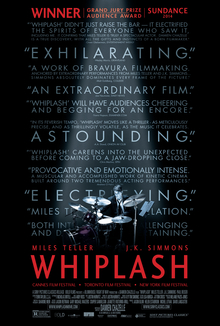
Every year, there are movies that I know I ought to watch but keep putting off because they don't seem like my cup of tea. This year, Whiplash was one of those movies. I had heard good things, but nothing that made me think I would love it. But oh how wrong I was. Having seen it, this is one of my favorite movies of the year.

The premise is simple. Miles Teller plays Andrew Neimann, a nineteen-year old freshman at the prestigious Shaffer Conservatory in New York City (cough Juilliard). He is a jazz drummer, and he aspires to be one of the greatest drummers the world has ever known. He tries to catch the eye of Terence Fletcher (J.K. Simmons), who is the conductor of the school's premiere jazz band and is the man who can lead him to greatness. Unfortunately, this is not some Good Will Hunting-esque professor who will kindly teach Andrew how to achieve his dreams and wisely prepare him for the world. Fletcher is a foul-mouthed, chair-throwing, abusive, manipulative monster of a man and Whiplash is the story of what happens when you put two unlikable but insanely driven perfectionists in a room and force them to challenge each other.

Written and directed by Damien Chazelle (based on his own hellish personal experiences as a drummer in a high school jazz band), Whiplash is a breathtakingly frenetic and fantastic movie. I don't know anything about drumming, but Miles Teller certainly seemed to be drumming the hell out of every scene, and J.K. Simmons is simply terrifying, unpredictable, and brilliant. This should not be an easy movie to watch, but you cannot tear your eyes away from the screen as you see these two characters push themselves to the limit, scale the heights of insanity, and just keep going. All they care about is jazz, family and relationships be damned, and the drums pound relentlessly on until the final frame of the film.

Whiplash is a movie about music and the pursuit of unattainable standards of perfection. The final scene is the most pulse-pounding, magnificent thing I witnessed all year and showcases the power of cinema to just sweep you away without a single word. The astonishing music, the tight frantic editing, the sweat and blood pouring on to the drums: it's simply incredible. J.K. Simmons is assuredly walking away with an Oscar for this performance, and Damien Chazelle is a very solid contender for Best Adapted Screenplay. Whiplash is what independent cinema is all about: taut, intense, dramatic stories that start small but blow up into epic tales. It is a spellbinding piece of work.

Sunday, January 25, 2015

Dear Committee Members: A Darkly Hilarious Tale

There's nothing I admire more than a good epistolary novel. Telling a whole story simply through a series of letters is a feat that amazes me, and Dear Committee Members by Julie Schumacher is no exception. This is also an absolutely hilarious book that revels in its absurdity and explores some dark truths about the perils of academia, publishing, and gradually fading ambition.

The novel consists of a series of recommendation letters penned by Professor Jason Fitger, a Creative Writing and English professor at Payne University somewhere in the Midwest. Fitger has written more than 1,300 recommendation letters for students and colleagues (he keeps careful records of all these missives) and at this point in his life, they are clearly starting to take a toll. His writing style is blisteringly sarcastic, long-winded, and self-important. Regardless of who he's writing to and who he's recommending, each letter manages to feature several references to his own miserable lot in life and the various complaints he has against the college administration, the state of publishing, the insidious plague of technology and e-mail, and of course, the unnecessary hell of having to write recommendation letters.

Whether it's Fitger's rants about the Economics Department--which gets oodles of funding while the English Department slowly loses professors, is clouded in a construction-induced asbestos haze, and is led by a clueless Chair from Sociology--or his increasingly frantic attempts to cajole his ex-wife and ex-girlfriend into doing him favors for his students, or his furious tirades as he attempts to complete online recommendation forms, you won't be able to stop laughing as you make your way through this novel. It's also amazing to see how Fitger's writing style changes depending on whom he's addressing and the subject of the letter. His genuine recommendations reveal him to be someone who does care for his students and wants them to succeed in life, but that goodwill is largely undermined by his cantankerous and overbearing nature when he tries to teach others a lesson and rail against the death of the liberal arts in the face of modern technology and science. There are also intriguing moments when you realize that you are just reading his letters, not his mind, and that perhaps you can't trust everything he has committed to the page.

Dear Committee Members has moments of darkness, of course, but by and large, it is a spectacular character study, and a witty look at what it means to be an academic in the humanities today. It is a refreshingly quick read (you can easily polish it off in a few hours) but once you do, you'll probably just want to re-read it. It is a brilliant, biting novel that made me wonder if any of my professors wrote such horrific recommendation letters for me when I was in college. I certainly hope not, but in hindsight, it would have been really funny if they had. 

Saturday, January 24, 2015

The Theory of Everything: Love & Physics

I was under the impression that The Theory of Everything would be very similar to The Imitation Game. Both are movies about brilliant British scientists who did extraordinary things in their fields yet faced tremendous personal hardships. However, I was pleasantly surprised to discover that rather than being a biopic about a lone genius, The Theory of Everything is much more focused on the relationship between Stephen Hawking and his first wife, Jane, and their extraordinary journey together.

Perhaps this is not surprising, as the movie is based on Jane Hawking's memoir Travelling to Infinity: My Life With Stephen. Felicity Jones plays Jane, who meets Stephen (Eddie Redmayne) in Cambridge and is captivated by this slightly awkward but funny and brilliant physicist. When Stephen is diagnosed with Lou Gehrig's disease and given two years to live, Jane refuses to leave his side, and insists that they spend whatever time he has left with each other. They get married, have children, and despite Stephen's rapid physical deterioration, he somehow continues to defy the odds. His scintillating theories on black holes and the origins of the universe earn him his PhD and while he now has to resort to a wheelchair and has increasingly slurred speech, he is still earning academic accolades and delivering brilliant lectures to his astonished peers.

The script by Anthony McCarten beautifully and lovingly portrays the heartbreaking evolution of their relationship. As Stephen becomes more debilitated, Jane gets more overwhelmed, unable to take care of him and their children full-time while also pursuing her own academic career. They both develop emotional attachments to other people but are still bonded by their enduring love for each other. It is easy to see how these two incredible people came together, but equally easy to see how they gradually moved apart.

Redmayne and Jones deliver simply astonishing performances and they fully deserve all the accolades coming their way. I expected this to be completely Redmayne's picture - after all, he is portraying an iconic figure who changed the world and defied all expectations. His performance is spectacular; he completely morphs into Hawking, gradually letting his limbs lose their function one by one until he is finally transformed into the wheelchair-bound, robot-voiced Professor that we all know today. But Jones is equally marvelous, portraying a strong, extraordinary woman, who fully embodies the idea of "the woman behind the man." She captures all of Jane's wit, intelligence, strength, and vulnerability, and it is clear to see that the Hawking household did not contain just one genius.

The Theory of Everything is a wonderful romantic tale, anchored by two incredible performances, an impeccable script, a moving score by Johann Johannson, and solid direction by James Marsh. It is uplifting and triumphant, and a glorious behind-the-scenes look at a very famous man and the woman who helped him achieve his dreams. 

Thursday, January 22, 2015

Wild: Grief, Courage, and Letting Go

When this year's Oscar nominations were announced, it was disheartening to see how almost all of the Best Picture nominations were for movies about men. The lack of female leads in the Best Picture race is appalling, but at least the Best Actress field showcases five movies where women truly delivered the goods. After watching Wild, you will be astonished by Reese Witherspoon's performance and strongly reminded of just how fantastic it is to watch movies where women get to just be themselves.

Wild is based on the memoir of the same name by Cheryl Strayed. It is the story of her 1100-mile hike along the Pacific Crest Trail, a journey she embarked upon on as a way to start afresh after a particularly heinous period of her life. After the death of her beloved mother a few years ago, Cheryl had spiraled into grief, destroying her marriage, engaging in casual sex and heroin use, and generally unable to find any purpose to her life. By hiking along the PCT, she hoped to finally deal with her wild grief and come to terms with her turbulent past before embarking on her future.

Director Jean-Marc Vallee and writer Nick Hornby have created a dreamy, beautiful movie that chooses to follow a free-associating narrative rather than a wildly conventional biopic form. It is anchored by Cheryl's journey, counting the days and miles hiked, but most of the movie is told in flashbacks, accompanied by beautiful images, weird hallucinations, dreams, and nightmares. This movie is "wild" in every sense of the term; the locations are primitive and awesome, Witherspoon's performance is raw and unrelenting, and every scene contains an unflinching maelstrom of sadness, beauty, and perseverance.

We are so used to seeing men embark on these journeys but it is extraordinary to see a woman on her own, free to explore her psyche and think about her life, unfettered and unbound by convention. The movie doesn't shy away from the dangers of being a lone woman hiker, and Cheryl has to deal with her fair share of creeps on the trail, but she has already endured so much in her past that she is more than equal to the challenge. She endures innumerable physical hardships, but the emotional scars are the ones that bleed the most. The flashbacks to her mother (played wonderfully by Laura Dern) deeply resonate, giving us a sense of who this woman was and the enormity of her loss that has led her to this present moment. It is a courageous and devastating story that is wonderful to witness.

Wild is a spectacular movie that tells a very necessary and moving tale. From beginning to end, you are side by side with Cheryl on this journey and you emerge at the other end of the trail with a sense of fulfillment and gratitude. I did not know just how much I had missed watching a woman fearlessly lead a movie until I saw Wild. I can only hope that 2015 gives us many more movies about women, by women, for women. 

Tuesday, January 20, 2015

The Imitation Game: An Unsung Hero

Alan Turing was a British computer scientist who is widely considered to be the father of theoretical computer science. He was a genius and a war hero, but owing to the classified nature of his work during World War II and the unjust treatment he received in the 50s after being prosecuted for homosexuality, he remained largely unknown to the British public. In recent years, there has been a growing movement to restore Turing to his rightful place in the British consciousness and The Imitation Game does an excellent job of bringing this man's story to the world.

The movie opens in 1952, when Turing (Benedict Cumberbatch) is brought into police custody for some mysterious reason. His voiceover begins to tell his story and we are transported back to 1939, at the outbreak of World War II, when the young Turing arrives at Bletchley Park for a job interview. Despite a fractious conversation with Commander Alastair Denniston (Charles Dance), Turing is too intelligent to ignore and is hired to be a part of a team of cryptographers tasked with cracking the German Enigma code. The team consists of a group of men who are mostly trying to break the code by trial and error but Turing knows the only way to tackle Enigma is to develop a machine that can quickly go through the millions of permutations and break the new code every day. Therefore, he sets out to design a giant machine to solve this giant riddle. His team thinks he is insane and there is a great deal of friction among them, but when he hires the brilliant mathematician, Joan Clarke (Keira Knightley), she becomes his guide to how to interact with his team and work together to save the world. 

The movie zigs and zags between time periods, alternating between Turing's boarding school years, his time at Bletchley, and his later years in Manchester. As the movie progresses, you see how screenwriter Graham Moore's script is cleverly weaving in elements from different times and giving us an insight into how this man's very complicated brain might work. The meat of the story is what transpires in Bletchley Park and Benedict Cumberbatch wholeheartedly steps into Turing's skin, bringing all of his intelligence and social awkwardness to bear. Knightley is a welcome addition to the male-dominated cast and is able to bring a much-needed dose of feminine intelligence and drive to the movie, even if she has no other women to talk to. Her struggles to be a career woman in this conservative era are on par with Turing's struggles to just get along with his peers and the two of them play marvelously off of each other and the rest of the cast. The other characters are rather stereotypical, but the actors playing them are excellent. You have Matthew Goode as the roguish Hugh Alexander, Allen Leech as the seemingly affable John Cairncross, and Mark Strong playing the macho and mysterious MI6 man in the shadows. It's a great British ensemble and while the dialogue sometimes get very predictable, it never stop being entertaining. 

The Imitation Game is a story about unconventional people that is told fairly conventionally by director Morten Tyldum. However, it is elevated by the engaging subject matter, the superb performances, and its ability to be funny, sympathetic, and devastating. The score by Alexandre Desplat is wonderful, a sort of digital symphony that captures the urgency and beauty of Turing's work as he races to crack Enigma and bring about an end to the war. While the script takes many historical liberties, it captures the broad strokes of this man's extraordinary life and the extraordinary team of people in Bletchley who may have helped save 14 million lives by cracking Enigma. After setting Turing up as the brilliant figure that he was, it is then heart-wrenching to view his eventual downfall as he is cruelly prosecuted for his homosexuality and eventually forgotten by the world. Thankfully, with this movie, he is being restored to his proper legacy and will remain forgotten no longer. 

Sunday, January 18, 2015

Selma: Past & Present

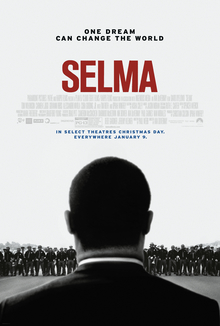
Given the current political climate, there is no more apt time to watch Selma, the story of the 1965 marches from Selma to Montgomery, Alabama to protest racial injustice and demand equal voting rights for African Americans. The day after I watched this movie, the news was filled with images of people marching in Paris and I was shocked at how much those images from 2015 echoed the images from 1965. People standing together in the aftermath of violence and peacefully expressing their solidarity and hope for a better future. It's both sad and beautiful to see how things haven't changed.

I won't go into further details about the plot of Selma because you need to see it unfold on the screen for yourself. Director Ava DuVernay has done a simply awe-inspiring job of constructing a movie that is both compelling yet difficult to watch. There are shocking moments when you feel like you have been brutally tricked into witnessing something you never saw coming and then other moments when you feel uplifted and roused by the powerful rhetoric of Dr. Martin Luther King, Jr. and the men and women who are fighting so hard to change the world. King is played by David Oyelowo, an actor who ought to be winning awards left and right for this performance but seems to have been unconscionably snubbed. He fully captures the magnetism and power of the man and the strength of his convictions; every time he got on a podium and started to speak, I wanted to stand up and cheer.

Apart from the speeches, however, DuVernay and Paul Webb's intelligent script manages to capture the more subtle theater of orchestrating these civil rights campaigns and figuring out the logistics of where a protest will be most effective and have the greatest impact. King's conversations with President Johnson (played very effectively by Tom Wilkinson) are vital to demonstrating the administration's initial hesitations and the push that was needed to get the Voting Rights Act passed in Congress. More importantly, King's conversations with his fellow activists highlight the complexities of the fight and the difficulty of focusing on just one issue when the injustices were so widespread. Selma features a truly wonderful ensemble cast, including Carmen Ejogo, Andre Holland, Common, Wendell Pierce, Oprah Winfrey, and more, all of whom represent key players in the civil rights movement who had tremendously important roles. They have their own private battles, victories and defeats, but they are all united in this show of non-violent protest to demand their right to participate in their democracy. In fact, King is far from being the hero of the piece; it is abundantly clear that this is a movement that depended on many heroic men and women to bring about social change.

Selma is shot beautifully, edited meticulously, and crafted with care. The soundtrack is particularly effective, featuring several different genres of music that are all equally evocative and come in at just the right moment for every key scene of the film. By focusing on such a specific period of history, rather than trying to encompass all of King's life, the movie manages to capture so much more nuance and detail about the struggle for civil rights and the accompanying heartbreaks and successes. It is a wonderfully acted, thoughtful, and engaging look at an incredibly fraught period in American history. It offers a glimpse at the very human man behind the legend of Dr. King, and while it is not overly critical of the people involved, it certainly exposes them all as human beings with their individual fears and failings.

The most sobering thing about Selma, of course, is how relevant it feels to the present day. Back in 1965, people were claiming that race was no longer a problem in America since African Americans had the right to vote. The Selma marches were a reminder that having the right to vote was not the same as actually being able to vote. Now, in 2015, we still live in an America where people claim to be living in a post-racial society while unarmed black teenagers are unlawfully killed and voter ID laws come back into effect to disenfranchise poor minority voters. Selma is a brilliant look at what tenacious and intelligent people achieved in the 60s, but it is a reminder of how much still remains to be achieved in the 21st century. We shall overcome some day, but not today.

Friday, January 16, 2015

Big Eyes: A Bizarre True Tale

Big Eyes may be directed by Tim Burton but rather than being weirdly Burtonesque, it feels more weirdly Wes Andersonesque. Perhaps this impression was heightened by the inclusion of Jason Schwartzman as a snooty art gallery owner, but overall, this is a vivid, colorful, oddball of a movie, made all the more bizarre because it is based on a true story.

We are first introduced to Margaret Ulbrich (Amy Adams) in the 1950s. She has just left her no-good husband and is driving to San Francisco with her young daughter to start a new life. She is an artist who loves to draw pictures of children with big, sad eyes and as she desperately tries to find a job, she sells paintings and caricatures to make some money on the side. While selling caricatures in a park, she meets Walter Keane (Christoph Waltz), a devilishly charming man who takes a shine to Margaret and her artistry. Following a whirlwind romance, the two get married and Margaret starts signing her paintings with the name "Keane." Walter, who can never get anyone to buy his generic paintings of Paris that he paints from his memories of the one week he spent in France, happens to show off some of Margaret's paintings and discovers that there's interest in her work. Ever the showman, he pretends to be the artist, and with his marketing savvy and ability to schmooze, the Keane art empire takes off. 

You would have gathered all that plot from the trailer but I was surprised and appalled as the movie progressed to find out just how devious Walter was. His lies grow exponentially and it's quite shocking to realize that you, as an audience member, have been taken in by this man just like Margaret. It is also delightful to cheer for Margaret as she gradually realizes what a corner she has painted herself into (pun intended) and starts to make her way out. Amy Adams is unsurprisingly fantastic and she makes you root for Margaret all the way through this movie. This is a woman who could be frustratingly naive, yet Adams' portrayal, Tim Burton's careful direction, and the thoughtful script by Larry Karaszewski and Scott Alexander help you understand all of her motivations and how she was manipulated into this terrible position. There's a fair amount of social commentary, showcasing how women were told to stick to their proper sphere and be good wives and mothers with no ambitions of their own. Christoph Waltz is a brilliant villain, preening and pompous and buffoonish, yet still hilarious and weirdly credible. He and Adams play wonderfully off each other and it's easy to see how Margaret could have initially fallen for this man, only to then discover his petty lunacy. Perhaps the most startling thing about Big Eyes is how the more outrageous parts of the story are actually taken from real life. This is such a preposterous story that it turns out it just had to be true. 

Big Eyes is a fun, entertaining movie that has the ability to genuinely surprise you. It is bizarre and beautiful and chock full of great performances. Amy Adams deservedly won a Golden Globe and while the movie may not win any more awards by virtue of being more of a comedy than a drama, it certainly deserves to be seen with the biggest eyes you have.