Friday, November 19, 2021

Beautiful Black and White: Passing & Belfast

If, like me, you love classic cinema, you are always cautiously optimistic when a modern movie comes out that is filmed in black and white. Is it a gimmick? Yes. But is it often deployed to wondrous effect, particularly given advances in cinematography and digital film? Yes. So today I present to you two new movies that are shot in black and white for very different but equally fascinating reasons.

Passing: Written and directed by Rebecca Hall (this is her directorial debut as she joins the ranks of actresses turning into directors, a trend I fully support), based on the novel by Nella Larsen, this is a quiet but tense movie about two Black women in 1920s New York, one of whom is light-skinned enough to be “passing” as white. The movie begins when Irene (Tessa Thompson) runs into Clare (Ruth Negga) downtown at a swanky Manhattan hotel. Clare recognizes Irene and comes over to have a glorious reunion with this woman she hasn’t seen since high school. The trouble is, Clare is pretending to be white, while Irene has merely been indulging in a wild moment to see if she can “pass” in this hotel, but is otherwise a very proud Black woman who lives up in Harlem with her “dark” husband and children.

What follows is a fraught story of a tenuous friendship that is based on lies from its very foundation, and is perpetually dancing on a razor’s edge of danger and destruction. Clare is married to a racist white man (played by Alexander Skarsgard, in an inspired bit of casting for the “whitest man alive”), but her reunion with Irene reminds her of how much she misses Black culture and freely hanging out with her own people. So she keeps coming up to Harlem and starts insinuating herself into Irene’s life in increasingly problematic ways that make Irene start to question her own life. And of course, there is the constant thrum of the question of “the race problem” in America, with Irene and her husband struggling with how to help their sons deal with racial abuse casually hurled at them in school or on the streets, and whether they should leave the country altogether. 

Shooting this movie in black and white is a very literal choice - after all, it’s about the state of Black and white people in America. But the cinematography and lighting has such a lot of technical wizardry and thought behind it. In scenes where the women were “passing,” the filmmakers would flood the sets with light so that it would be difficult to ascertain the actors’ skin color. There is so much psychological and physical nuance to play with in this story, and both Thompson and Negga are incredible at capturing all the struggles these characters face, not just because of their Blackness, but also because they are women. Clare is in such a dangerous position - she technically has everything she could want because she married a rich white man, but she will be destroyed if he ever finds out her true identity. The notion that she spent her entire pregnancy in a wretched state because she had to pray her child would be born light-skinned is horrific to contemplate. This woman has made the ultimate deal with the devil and as the movie progresses, you will get to see how that deal turns out and the toll it takes on the people around her. This story may be from the 1920s, but its themes are just as relevant today where racism and colorism continue to run rampant. So settle in and watch Passing. You will have a lot of food for thought.

Belfast: Written and directed by Kenneth Branagh (another actor turned director!), this is a very personal original screenplay based on his childhood in Northern Ireland during the Troubles, and the agonizing decisions his family had to make as to whether or not they would have to leave Belfast and all the people they loved. Despite the heavy subject matter and all the chaos and rioting unfolding on screen, the movie is surprisingly light and deft because it is told from the perspective of 9-year old Buddy (the wondrous Jude Hill, who is going to pick up all manner of Young Artist awards this year). Even the camera angles are often designed to show you this world from a child’s vantage point, because you’re always looking up at things or having the adults loom over you while they talk. 

Speaking of the adults, Jaime Dornan and Caitriona Balfe play Buddy’s parents, while Ciaran Hinds and Judi Dench are his grandparents. That’s some all-star casting right there, and they are all magnificent, particularly Balfe who has to carry the heft of being a woman raising two sons in the middle of all this chaos while her husband only comes in every other weekend as he’s working on jobs in England and trying to make enough money to support the family. This couple is struggling and you get to see the emotional decisions and fights that are taking place as they try to protect their family amidst all the sectarian violence. They are Protestants, but they live on a street with a lot of Catholic folk that they love and consider family. However, they are increasingly being pressured to join violent Protestant gangs and the entire situation is unfathomable.

Throughout this tension, however, Buddy is just being a regular kid, struggling to do well on his homework to impress and (literally) get close to a smart girl in his class, and indulging in his love for movies, TV, and theater that heralds the future Sir Kenneth Branagh that he will become some day. At one point, there’s a scene of Buddy avidly reading a Thor comic and it made me laugh as that was a clear homage to Branagh directing the first Thor movie for Marvel, which at the time felt like an odd choice for the mostly Shakespeare-focused thespian. 

The black and white cinematography in this movie is simply sumptuous, capturing the nostalgia and beauty of this time despite all the hardship, and I don’t think any of these actors have ever looked better. It’s an odd thing to say, but I’ve never been more aware of how blue their eyes are than when I saw how clear they looked in black and white. And I love nothing more that looking at a beautiful old wrinkled face in black and white - God bless Judi Dench, but her wrinkles and un-Botox’d face have never looked lovelier on the big screen. However, this movie does periodically have color: when Buddy is at the movies watching something in glorious technicolor, or watching a theater production. The effect makes it clear that this is when his world comes alive, and no matter all the heartbreak and angst going on around him in the quotidian sufferings of mankind, he can always escape to these places to find worlds that are new and exciting and joyous. 

Ultimately, Belfast is a glorious cinematic memoir, a perfect encapsulation of why Branagh became the man he did, and a loving ode to his childhood and the people who suffered so much through the Troubles. This movie is probably the first time I have seen an insider’s account of how it felt at the time and all the religious rhetoric and human idiocy that went into the escalating tensions. The movie’s dialogue can get a little hokey in places, and Buddy’s family can often seem quite saintly in their tolerance and common sense approach to religion and other human divisions. But in our increasingly frayed and polarized times, this film is a welcome reminder that humans have always sown unnecessary discord amongst themselves, and what we really need is to move beyond that and recognize our common humanity. Stop fighting each other and go watch Chitty Chitty Bang Bang. That’s my biggest takeaway from watching Belfast.

Tuesday, November 16, 2021

Let's Get Ready for Romance: Love Life & Love Hard

It's November. The weather's getting chilly, the holidays are fast approaching. It's time to snuggle up with some stories about people falling in love! If you want something insightful about modern romance and the turbulent journey towards finding "the one," I've got you covered. If you want a silly, predictable, and thoroughly delightful Christmas romcom? I've also got you covered.

Love Hard: When the preview for this movie popped up on my Netflix account, I watched ten seconds and could already predict everything that was going to happen. And I immediately knew that didn't matter and I was going to watch the shit out of this film. Which I proceeded to do, and I enjoyed every minute. I regret nothing.

This is a classic tale of a woman named Natalie (Nina Dobrev) who has had terrible luck on dates but then connects with a man named Josh on a dating app. She lives in LA, he lives all the way across the country in Lake Placid, NY, but she is texting this guy all the time, talking to him on the phone constantly, and then finally, she decides to take a leap of faith and show up at his doorstep right before Christmas so they can spend the holidays together. Well, when she shows up, it turns out he catfished her, and looks nothing like the hunky Asian in his profile pic, but is more of a regular-looking Asian (Jimmy O. Yang). So that relationship is not going to work, but she discovers that Josh used the photos of a very real man who lives in his town, a guy named Tag (Darren Barnet). Josh has known Tag since childhood, so he agrees to help Natalie woo Tag, in exchange for her pretending to his family that she really is his girlfriend for the holidays. What could go wrong?!

That plot is basically a collection of twenty romcom storylines in one go. And as you watch this movie, you'll spot loving homages to all the traditional holiday romcom tropes, including a whole scene dedicated to Love Actually and an argument about whether or not Die Hard can be classified as a Christmas movie. It's so silly but these actors are so game and charming and you can't help but be swept away in the silly sparkle of it all. You know exactly how this whole thing will turn out, but watching all the zany escapades on the road to happily ever after is a joy. And as with any Netflix production, the soundtrack is an absolute banger. In fact, the final scene featured a gorgeous song that I had never heard before but am now obsessed with, and for that reason alone, I love this movie. Hard.

Love Life: This is an anthology show about modern-day New Yorkers and the relationships they have before they finally find their "person." The first season starred Anna Kendrick as Darby Carter, while the second season stars William Jackson Harper as Marcus Watkins. I actually started watching Season 2 first, but then binged Season 1 before I finally finished the second season. Which is a very convoluted way of doing things, but I had my reasons. However, I recommend you just watch this show in order because, while Darby is not a central figure in Season 2 at all, she does occasionally have some cameos, and it's helpful to know at what stage of her life she is in as she intersects with Marcus in his journey. 

Each episode of the show focuses on a different relationship the protagonist has with another person. Most often, these are romantic relationships, and you will follow along as these people go through messy break-ups, one-night stands, meaningful long-term relationships, and lots of meaningless hookups. But some of the episodes are also about the relationships Darby or Marcus have with their friends or their family. And ultimately, this is a show about how you can't just expect the people in your life to give you everything you want without first working on yourself. 

This is a fantastic show, but if you find yourself uninterested after watching the first season, please just start watching the second season, because it gets even more profound and meaningful. Episode 9, in particular, deals with the pandemic and the unsettling loneliness that people experienced during that time. There has been a lot of storytelling about 2020 lately, but this half-hour episode of a romantic TV show perfectly encapsulated the entirety of the pandemic, from the initial paranoia and constant sanitizing, to the eerily empty streets of New York, to the social etiquette of fist bumps, masks, and social distancing, and the constant chatter about whether we're ever getting a vaccine. This is such a clever show about love and relationships and complicated interpersonal dynamics and finding yourself before you find a partner, but this one episode also served as a perfect time capsule of human experience at this fraught moment in history. 

Created by Sam Boyd, and written and directed by a slew of talented people, give this show a try. Yes, it's a mostly heteronormative and traditional view on romance. But I can guarantee there will be multiple episodes that deeply resonate with your psyche, and I also promise, you will get a happy ending, even if there are a lot of bumps along the way.

Friday, November 12, 2021

Eternals & Last Night in Soho: Thrills & Chills

This weekend, I bring you reviews of the next Marvel movie and the next original movie from Edgar Wright. Pick your poison, or if you're like me, watch them both!

Eternals: I'll tell you right now, this was not my favorite Marvel movie. I go to Marvel for a lot of comic relief and great action sequences, and this movie was only intermittently funny (mainly when Kumail Nanjiani was on screen, which really was fantastic). There was a romantic subplot with some swoony lighting and intimacy to remind you that director Chloe Zhao excels at this kind of storytelling. But then some Deviants, who are these alien monsters that are absolutely gorgeous to look at but not fun to fight, would show up and battles had to commence. 

This movie opens with several paragraphs of text to provide the back story of who the Eternals are, so I already knew this was going to be a bit beyond me. My preference for plot exposition is always show, not tell, but man, there was a lot of gobbledy gook to get through about all the different characters and their mission. Also, this movie offers up a condensed history of the human race, so you will get to see battle sequences ranging from the early Mesopotamian civilization all the way up to modern day London. The production design and special effects are as wonderful as you could expect, but it's definitely a lot of information to take in for two and a half hours.

I never got bored while watching this movie, but it's been a week since I saw it and I'm already struggling to remember much about it at all. The cast is great, and it's wonderful to see such a range of diversity in a group of superheroes. Obviously, I had a soft spot for Nanjiani as a brown superhero, Kingo, who has a whole Bollywood subplot that made me giggle. But there's also Brian Tyree Henry playing Phastos, who is the first gay Marvel superhero, and Lauren Riddloff as Makkari, the first deaf Marvel superhero. All of this makes for interesting pairings among the Eternals, and I loved that they were all being wrangled by Salma Hayek as their leader, rather than Richard Madden, who I had been conditioned to assume would be the leader as he was the only white man. But you've also got Gemma Chan, Angelina Jolie, Don Lee, Lia McHugh, and Barry Keoghan rounding out this cast, and that's just the Eternals! So you can see why there's so much heavy lifting to be done plot-wise. This does allow for interesting combinations of all these characters in different scenes where they get to play off each other and throw down against aliens, but it's also a lot to keep track of.

Watch this movie for some quick and dirty traditional Marvel entertainment. But if you already know that superhero movies are not your thing, this is not the film that will change your mind. It's a great cast, but the story is a bit blah, so make your decision accordingly!

Last Night in Soho: I love Edgar Wright and will watch anything he does. So I was very excited by the trailers for this movie and had been jonesing to finally see it in theaters. And it certainly lived up to all my expectations. 

The trailer will set you up for everything you need to know but here's the plot in a nutshell. A young woman named Ellie (Thomasin McKenzie) moves to London to study at the London College of Fashion. She grew up with her grandmother and loves the music and fashion of the sixties. Shortly after moving, she starts to have incredibly vivid dreams where she is transported back to 1960s London and follows a woman named Sandie (Anya Taylor-Joy) as she tries to become a singer at a nightclub. At first, everything is fun and games and Ellie looks forward to falling asleep each night so she can see what dazzling adventures Sandie will get up to during her favorite time period. But Sandie's life starts to take a turn, and Ellie realizes she is now trapped in a horrific nightmare. 

You really have to experience the rest of this movie for yourself. It is such a sumptuous piece of cinema, with an incredible score, the most remarkable costumes, and bright, colorful, vivid cinematography and all manner of camera tricks and sleight of hand as you start to see Ellie and Sandie meld into one person. It's hard to explain, but take my word for it, this movie is just a delightful feast for the senses and a clever tale about the dangers of getting too caught up in nostalgia.

Of course, it's also an Edgar Wright movie, and when things take a turn in this film, they REALLY take a turn. This man did earn his stripes making horror films (though only funny horror, my preferred kind), so you can expect some jump scares and horror elements. I did not think these were extreme enough to classify this as a horror film, but depending on how much of a scaredy cat you are, your mileage may vary. But honestly, even if you can't stand horror, you should probably watch this movie anyway (you can close your eyes during the scary bits) because it's so gorgeous to look at and so inventive. So give it a shot and spend a night in Soho. You'll have a swingin' time.

Thursday, November 11, 2021

Maid: The High Cost of Being Poor

I read Stephanie Land's memoir, Maid, last year and loved it. So it made sense that I had similar feelings about the Netflix series that is "inspired" by her memoir, though apparently not directly based on her life, for what I assume are convoluted legal reasons. Like the book, the show is incredible, and incredibly sad. It's important that people watch this show and/or read the book, because there is a perpetual narrative in this country about how poor people just need to pick themselves up by their bootstraps, and the one thing that this story made clear to me was the number of ways in which society fails our most vulnerable citizens and throws obstacles in their path so they will never in fact be able to pick themselves up. So no, this is not a feel-good recommendation, but it's still a very hearty recommendation for an eye-opening and valuable lesson in the need for better social safety nets.

Margaret Qualley stars as Alex, a young woman who leaves her abusive boyfriend, Sean (Nick Robinson), in the middle of the night with her two-year old daughter, Maddy (Rylea Nevaeh Whittet). Over the course of ten episodes, we follow this woman's journey through government bureaucracy and dysfunctional family dynamics, as she desperately tries to find any way to earn some money so she can take care of her child, while encountering a neverending series of seemingly insurmountable obstacles. In some scenes, there is a running tally in the corner of the screen of how much money Alex currently has. This was a narrative device in the book as well, and has been effectively translated to the screen so you can literally see how this woman is living from dollar to dollar and the toll it can take when she has to put gas in her car and therefore choose if she will be eating a meal that day. When she gets a job as a maid (with carefully restricted hours, natch, so the owner won't have to give her any benefits beyond her paltry salary), we see how quickly her paycheck is used up through the simple act of buying cleaning supplies, getting gas for her car, and then having to take a ferry to get across to the house that she has to clean. When a customer unexpectedly cancels, she might not not have enough money to pay for Maddy's daycare, which means she then can't leave her kid alone to go work, which means she's stuck in this horrific grinding cycle of poverty.

Most people have an abstract notion of how it must suck to be poor. There's a lot of rhetoric of how if people just stopped buying Starbucks and avocado toast everyday, they'd have enough money to pay for everything. But Maid showcases how people who are merely looking for the bare necessities of food and shelter are constantly thwarted and beaten down by those in society who have the privilege of never knowing that grinding worry of making ends meet. Alex cleans the house of a woman named Regina (Anika Noni Rose), who is a wealthy lawyer and lives in the lap of luxury. The evolution of that relationship is wonderful, with Regina having absolutely no clue what Alex's life must be like, and slowly learning to check her assumptions and understand what happens when Alex is not in her house. It's a gradual reckoning, and it isn't perfect by any means, but it offers up one example of the kind of education in empathy that all rich people need before they realize what it means to be poor in America.

Obviously I'm an incredible fan of the writing of this show and the thought and care put into this adaptation by creator Molly Smith Metzler. But none of it would work without the scintillating acting from this cast, particularly Qualley and Andie MacDowell who plays her mother, Paula. The two of them (who are mother and daughter in real life!) play off of each other in such heartbreaking ways, and you can certainly see how Paula's struggles with her mental health and erratic life choices have weighed upon Alex, and how hard Alex is fighting to break out of this cycle before her choices end up weighing down Maddy and limiting her future. And I am already cringing when I say "choices" because the thing that this show makes so emphatically clear is how little "choice" these women have had in their lives. Each episode of the show can feel so predictable, because you'll think that things are finally improving for these characters and they have found a way to better their lot, but then they immediately take two steps back. And you have to check your impulse to blame Alex or Paula for their individual actions and instead acknowledge there is a whole social system that has let them down. They have suffered from abusive boyfriends, have not received appropriate health care or social services, and have generally been led to believe that they are less than, which makes it all the more remarkable to see how much they still accomplish and defiantly achieve every single day. 

Maid also boasts incredible production values. This is a well-shot show that is beautifully imaginative and comes up with economical and riveting ways to reflect a character's emotions or capture a mood. I certainly tried to binge this show but could only take it a a few episodes at a time with long breaks in between because it is quite painful and demoralizing to watch. And yes, the irony is not lost on me that I can't even watch a show about being poor, while millions of people have to endure that reality every waking moment. So please do watch Maid. It's an emotional slog, but from an acting and storytelling perspective, it's absolutely compelling and riveting and deserves all manner of acclaim. And when you're done, have a think about all the assumptions and preconceived notions you've been carrying around about poverty and try to be less of a terrible human. Maybe if enough of us get on the bandwagon, we can be less pretentious and ridiculous about helping people who are simply trying to help themselves. 

Friday, November 5, 2021

The Last Duel: Medieval #MeToo

I was cautiously optimistic heading into The Last Duel, because there were a number of reasons this movie was going to work for me. I left the theater satisfied, knowing that while it wasn't a perfect movie, it still hit some of my cinematic sweet spots. Let me count the ways.

1. The script. One of my absolute favorite narrative devices in TV and film is a Rashomon-style story where you see the same tale being told from the perspectives of different characters. Based on the true events depicted in the book of the same name by Eric Jager, this movie is set in medieval France and tells the story of Lady Marguerite (Jodie Comer), who is married to Jean de Carrouges (Matt Damon), and accuses his friend Jacques Le Gris (Adam Driver) of raping her. In three separate "chapters" we get each person's perspective on the events leading up to the assault, and it's an intricate and insightful look at how people view their own actions versus the actions of others, and can end up telling themselves different versions of the "truth." Matt Damon and Ben Affleck initially started writing this script themselves but thankfully realized they would need to bring a woman on board to tell Marguerite's story. So Nicole Holofcener rounds out the trio of screenwriters and you can feel her presence throughout this film whenever there's any commentary to be made about a woman's plight in the world. Which brings me to...

2. Gender politics. This movie is not subtle about its feminism. In ways that are sometimes a little grating, but given the times we live in, it seems like we can never over-emphasize the importance of women having their own autonomy. Needless to say, by the time we get to Marguerite's side of the story, you're going to have a pretty good idea of how this whole thing is going to go. Her chapter has much to say about how men are so oblivious about the way they view themselves in relation to the women in their lives, and believe they are the heroes, when they are so often the villains. There is nothing I find more disturbing in a movie than a rape scene, and in this film we get two. I was fascinated by all the subtleties between the two scenes: did Marguerite slip off her shoes or lose them while she was running away? Did she hold the bedroom door open or try to slam it shut? Did she scream for her servants once or twice? Did she protest mildly or vociferously? These two scenes aren't all that different, but those nuances are what build a damning case about what is the truth and what is a fantasy. And thanks to that Jodie Comer performance, Marguerite's perspective is searing and unrelenting.

3. The actors. Hands down, Jodie Comer is the best thing about this film. Of course, we then also have Damon and Driver who are no slouches. But unlike Comer, their accent work was quite abominable, with the two of them sounding increasingly American as the movie wore on. Also, the accents they were meant to have were British, which still makes no sense for a movie set in France, but that's Hollywood for you. Interestingly, the male actor that surprised me the most was Ben Affleck, who has a supporting role as Count Pierre. He kept that British accent going throughout, and served almost as comic relief, which was very entertaining in an otherwise heavy film. I don't know if he and Damon initially thought they were going to co-lead with Comer, but it was a wise decision on his part to take this role instead. Damon and Driver are perfect foils for each other, and as you watch their perspectives unfold, their "friendship" increasingly devolves into a petty, ugly thing, that culminates in the ultimate act of aggression.

Obviously, I think you should watch The Last Duel. Directed by Ridley Scott, it has a very Gladiator feel to it, with great care paid to production design. There's also a lot of attention paid to the costumes and armor being worn by these characters, and the elaborate hairstyles are also wondrous. However, this movie can get very anachronistic in terms of its tone and language. Having just read Matrix by Lauren Groff, a book that is meticulously researched and set in a similar time period, I did find the dialogue to be at times jarring. Forgive me if I don't buy that a fourteenth-century French knight would say "I'm broke" when discussing his finances. But I am not a medieval historian, so I'm willing to forgo those details in service of the larger story, which is compellingly told. You may not have heard of Lady Marguerite de Carrouges before this movie, but you won't forget her afterwards.

Tuesday, November 2, 2021

Fantastical Films: Dune & The French Dispatch

What do Dune and The French Dispatch have in common? They are both tropey fantasies that star Timothee Chalamet. I liked one and not the other, but depending on your temperament, you could easily like the other and not the one. Read on to get all the answers you seek.

Dune: Based on the novel by Frank Herbert, this is a classic science fiction fantasy about the young man who is destined to save the universe (Chalamet, natch) and all the machinations afoot to make him understand his place in the great world order. There is a ton of world-building as you need to understand the history of the planet Arrakis, which is a desert where the Empire mines a mystical substance known as “spice” that is critical to space travel. In classic human fashion, the people of Arrakis have been subjugated and ruled over by tyrants who exploited the spice trade for their own gain, but now the Emperor has declared that House Atreides will take over. Duke Leto (the beautiful Oscar Isaac) is the head of House Atreides, alongside his concubine, Lady Jessica (Rebecca Ferguson), and son, Paul (Chalamet). The Duke plans on being a benevolent ruler but is well aware of all the political entanglements he will face.

Adapted for the screen by Jon Spaihts, Eric Roth, and director, Denis Villeneuve, this movie does a great job of setting up all the random families, planets, and magical powers without having someone talk at you with a list of rules for an hour. I quite enjoyed the subtle (and not-so-subtle) narrative devices employed to deliver all this exposition. But mostly, just let this movie wash over you. You’ve seen all of this before, and it feels very Star Wars. The joy is in the production and costume design and getting to watch a bunch of people run around a desert for two and a half hours. Plus, if you’re in the Northern Hemisphere and starting to get chilly, you could stand to spend some time staring at a scorching desert and vicariously baking in the warmth reflected on the big screen.

Dune is a popcorn movie. It’s not cerebral, but it’s very entertaining, with a classic Hans Zimmer score that is designed to keep you awake (or give you a headache). The actors are all having fun (though I could have definitely used more Jason Momoa and Zendaya), the sets are all spectacular, and just don’t think about it too much OK? Go be entertained, and if the dialogue is periodically unintelligible, stare at the billowy costumes for a bit and soothe yourself. Sometimes, that is the best thing you can get at the movies, and Dune fully delivers on some mindless escapism. 

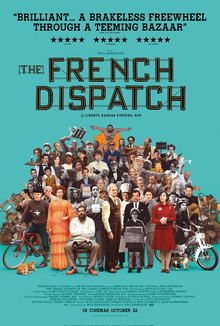
The French Dispatch: I like Wes Anderson. But when I saw the trailer for this movie, I thought this might be too much Wes Anderson for me to take. And having now watched the movie, I was correct. This is the twee-est film he has created to date, and also seems to firmly establish the fact that he is just doing his own thing and either you’re in or you’re out. Sadly, I was out. But if you’re a die-hard fan (you know who you are), go ahead and lap this up with a spoon. I do not begrudge you your joy.

If you’re on the fence, here are the basics. The movie is framed as the final farewell issue of a magazine called The French Dispatch, which serves as the foreign outpost of a fictional American newspaper called the Liberty, Kansas Evening Sun. What follows are a series of vignettes, which represent the articles in this issue, and serve as a not-so thinly veiled homage to The New Yorker. So Anderson gets to tell a bunch of different stories set in France about a motley crew of characters, comprised of the world’s wildest cast, including Tilda Swinton, Bill Murray, Frances McDormand, Benicio del Toro, Saoirse Ronan, Chalamet, Lea Seydoux, and dozens more. Seriously, if I had to name them all we would be here all night. Also, some of them are meant to be American, but the ones who are meant to be French are still doing their own accents, so YOLO.

This format means Anderson doesn't have to concern himself about plot as much and can be as stylistic as possible with his actors, sets, costumes, and dialogue. Half of the movie is also in black-and-white, with scenes occasionally being suffused in color so you can remind yourself of how much beauty goes into every frame of an Anderson picture, before he snuffs the color out again. I kept perking up at how pretty things looked but then had to settle back down when they went back to grayscale. There was a lot of interminably rambly dialogue and voiceover that had lofty ambitions of being meaningful and instead just bored me to tears. This movie was emphatically not made for me, but it is certainly visually arresting if that's your jam, and has the expected twinkly soundtrack that one expects of any Anderson movie. So try it if you're curious, but stay away if you already know that your mileage may vary. I suspect that for a lot of regular moviegoers, this movie is going to be way too cute to take your fancy.

Thursday, October 28, 2021

Weekend Watch: Only Murders in the Building & The Guilty

What do you feel like watching this weekend? A funny ten-episode New York mystery series? Or a gritty and claustrophobic cop thriller that will be over in 90 minutes? Either way, I’ve got you covered.

Only Murders in the Building: This show stars Martin Short, Steve Martin, and Selena Gomez as three residents of a swanky apartment building on the Upper West Side. When a resident named Tim Kono is found shot in his apartment, our three leads band together as an unlikely trio to investigate. And they also start making a true crime podcast to broadcast their investigation to the world in real-time, which means that as the series progresses, they start accumulating a fan base, and further complications ensue.

This show is my jam for three reasons: I love mysteries, I love satire, and I love New York. And this show hits all those elements and knocks them out of the park. Created by Steve Martin and John Hoffman, the show is well-written and hilarious, mining every possible situation for comedy gold as well as satirizing all the tropes of true-crime podcasts. The mystery of “who killed Tim Kono?” is truly engaging and over the course of ten episodes, you will encounter numerous red herrings (I won’t spoil, but a famous musician makes a cameo at the end of Episode 3 and it made me LOL), and many twists and turns. And the show is filled with New York banter (the opening credits look like they were pulled straight off a New Yorker cover) and a lot of jokes about how terrible Long Island is.

This is exactly the kind of light and breezy yet still compelling show that makes for a perfect weekend binge. It was great for weekly viewing, with my friends and I trading theories about what we thought would happen next, but now you can treat yourself to all of it in one fell swoop. The actors are wonderful, and while we all know that Short and Martin have great rapport after years of working with each other, it was fun to see how well Gomez fit in as the young millennial who still got along well with these two weird older men. So settle in on the couch and get started. I promise you won't regret it.

The Guilty: First off, if you are mad at the police and the status of policing in America in general, this may not be the movie for you. But if you want to watch Jake Gyllenhaal on the phone for 90 minutes acting his heart out, this might be your jam. Directed by Antoine Fuqua and adapted from the original Danish screenplay by Nic Pizzolatto (both men who are associated with movies and TV shows about problematic cops), the movie follows one day in the life of LAPD officer, Joe Baylor (Gyllenhaal). He is a cop who has been relegated to working as a 911 operator, for reasons that will slowly be revealed over the course of the movie. We see him deal with various 911 calls at the beginning, some of which are benign, others a bit more serious, and he either handles them quickly and flippantly, or gets annoyed and judgy. There’s a lot of “you put yourself in this dangerous situation by taking drugs, how dumb are you” energy, and overall, he does not seem like the kind of guy I would want to be relying on in a crisis.

However, he then gets a call from a frightened woman, and after initially thinking it’s a wrong number, he realizes this woman has dialed 911 because she has been kidnapped and needs him to save her. What follows is a tense thriller where Joe calls in every favor he can from his colleagues, engages in some questionable policing, and tries to coach this woman to safety. There’s a third act twist that is particularly amazing, though I kind of anticipated it from the jump, so I’m curious if other people did too. Let me know in the comments if you end up watching it!

This is a good movie if you want to watch a good actor put on an acting showcase. It was filmed during the pandemic, so there’s a particularly claustrophobic feel to the film as it is mostly centered on Gyllenhaal sitting in a room yelling on the phone. The character is complex and mostly impossible to root for, but the story is propulsive and compelling and has a satisfying resolution (I would argue almost too satisfying, as though it’s trying to make up for just how dark it is all the way through). Also, the voice cast is a who’s who of talent, but I was so swept up in the story that I didn’t even try to puzzle out who was doing all the talking until I got to the closing credits. So give it a try. It might be a lot to take in, but it might also surprise you. 

Bonus recommendation: The Guilty reminded me a great deal of the movie Locke, starring Tom Hardy, so if you are turned off by the idea of watching a cop movie, might I suggest you watch that instead? Hardy is great, and there's a lot of drama but with a soothing Welsh accent, so you may enjoy it a lot more!