Monday, October 6, 2014

Outlander: Sweeping Scottish Saga

A few weeks ago, I noticed several articles on Twitter talking about the seventh episode of Outlander. Airing on the Starz channel and based on a series of novels by Diana Gabaldon, this show was not on my radar. However, when the Twitterverse explodes, I listen. So I took the plunge, and eight episodes later, I have emerged in awe of the cast and creators of this show.

Outlander is the story of Claire Beauchamp Randall (Caitriona Balfe) an Englishwoman who served as a nurse in World War II. The war has just ended and she is reunited with her beloved husband, Frank (Tobias Menzies). They go to the Scottish Highlands for a second honeymoon and are having a wonderful romantic time. But one day, she wanders off by herself in a mystical spot, and is suddenly transported back to 18th century Scotland in the midst of a civil war. Bewildered and afraid, Claire slowly pieces together what has happened and her only hope is to return to the spot where she first traveled back in time. Unfortunately, events force her to run for her life and take up with a band of Scottish soldiers, who are mystified to find a strange Englishwoman running around the countryside. Thanks to her nursing background, she proves adept at healing them of their wounds, and though they still suspect her to be a English spy, they are grateful for her expertise.

One of those Scots is a handsome outlaw, Jamie (Sam Heughan). While his clansmen protect him out of a sense of duty, he is on the fringes of society due to the English having put a price on his head and he can bond with Claire over their shared sense of isolation. He becomes her friend and protector, and in the aforementioned seventh episode, he is forced to become her husband. I cannot write articulate paragraphs about why that episode was so special - other writers have done so brilliantly, discussing the clear value of it being written and directed by women who knew just how to make "The Wedding" such a spectacular hour of television. And in fact, all of Outlander is a brilliant piece of woman-centered television, telling the story from the viewpoint of its strong female lead and giving her a great deal more agency and wit than we ever get to see in these kinds of historical or fantasy sagas. Claire is surrounded by Scottish men, but she always holds her own and earns their grudging respect and admiration. The show features a great deal of Gaelic that is not subtitled - this can be disconcerting, but is meant to put the audience in Claire's shoes and empathize with her frustration as these men talk about her and decide on her fate. Claire's voiceovers drive the narrative and tell you what to think and feel at any given moment, and the show is all the better for it.

You should also watch Outlander for its sheer beauty. Shot in the wilds of the Scottish Highlands, each scene is achingly gorgeous and otherworldly. The music is soulful and stirring: just listening to the title song at the beginning of every episode transports you right into this world. The sets and costumes are all recreated with marvelous attention to detail, and the actors are committed to telling a wild and sweeping story of war, romance, and tragedy. The Scottish actors, particularly Sam Heughan and Graham McTavish, are fantastic, bringing such depth of feeling to their roles and sharing interesting dynamics with each other and Claire. Tobias Menzies has a wickedly difficult stunt to pull off as he plays Claire's adoring husband in 1945 England, but his psychopathic English ancestor, "Black Jack" Randall in 1743 Scotland. And Caitriona Balfe is a fearless marvel, diving headlong into every scene with courage and wit, daring the men around her to keep up. She allows Claire to be strong and vulnerable, intelligent and bewildered, funny and frustrated. And of course, this is thanks to the showrunners and writers, who are delivering powerful scripts every week that give these characters room to breathe and fully develop into complex human beings.

The first eight episodes of Outlander have already aired and the next eight will air in April. Given the richness and sheer joy of watching this series, it is perfect to binge watch in one go rather than having to wait for weekly installments. But I warn you, the final episode does end with a cliffhanger that is already making me pine for April. Thankfully, there are a stack of novels I can read in the meantime.

Sunday, October 5, 2014

Gone Girl: Creepy Brilliance

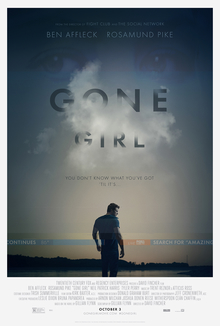
The last David Fincher movie I saw was The Girl with the Dragon Tattoo. Like Gone Girl, that film was an adaptation of a novel I loved, and when I saw it, I was mesmerized. So when I went to see Gone Girl, I had high expectations. This movie did not meet those expectations - it surpassed them.

I wrote about the novel in 2012, so if you want a basic plot summary, you can find it here. The movie follows the plot faithfully and manages to turn that incredibly tricky literary narrative into cinematic dynamite. This is due to the screenwriter being Gillian Flynn, who also wrote the novel and is therefore well-equipped to find the best way to intertwine two conflicting stories with flashbacks and deceptions galore. I cannot imagine what it must be like to watch this movie if you've never read the book (it is probably akin to the sheer joy I experienced when I read the book and came to the big reveal halfway through), but despite having read the book, I found this movie incredibly engaging. At two and a half hours, I worried it would be too long, but I was riveted throughout and fascinated to see these incredibly twisted characters that had only existed on the page suddenly come to life on the big screen.

Let's talk about those characters: Nick and Amy Dunne are the poster children for the worst marriage ever. They have their flaws (some slightly more extreme than others) and as the tale of their romance unfolds, you get to glimpse what brought them together and then drew them apart. Ben Affleck and Rosamund Pike are impeccably cast in the lead roles - Affleck captures the weird deadpan aloofness of Nick, who seems incapable of reacting appropriately when his wife goes missing, while Pike is beguiling and then terrifying as the inscrutable Amazing Amy. Neil Patrick Harris has a strangely creepy turn as Desi Collings, an ex-boyfriend who can't resist Amy's pull, while Carrie Coon (who did some amazing work in The Leftovers) plays Nick's twin Margo, a funny, sarcastic woman who is the only truly sympathetic character in the entire movie. Tyler Perry does an excellent job as Tanner Bolt, the lawyer who specializes in "wife killers," while Kim Dickens is marvelous as the suspicious and diligent Detective Boney who uncovers more than she can handle about this mystery. 

Gone Girl tells such a brilliant story that there is no way it could have been a mediocre movie. However, in the hands of David Fincher, it is a sublime film, a psychological thriller that creeps you out and amazes you with every twist and turn, yet maintains a black humor throughout. There are laughs to be had at various points in this movie, almost to allow the audience some room to relax before the next gripping set of scenes unfold. The hypnotic score by Trent Reznor and Atticus Ross is always pounding in the background, getting under your skin and making your hair prickle at all the right moments, driving the maddening urgency of this film until it reaches its epic conclusion. Like all of Fincher's films, the cinematography is crisp, haunting, and dark, vividly capturing the mood of this small town and the tragedy as it unfolds. Each scene is filled with shadows and secrets, clues lurking and waiting to reveal themselves in due course to lend yet another manic twist to this tale. 

Like the book, the movie is a treat that leaves you thrilled at what you've witnessed, yet also slightly appalled. Fincher was the perfect director to capture the dark and bizarre world of Gone Girl; thanks to his cast and crew, he has managed to create a masterpiece.

Saturday, September 27, 2014

This Is Where I Leave You: Mourning with Laughter

If you've seen the trailer for This Is Where I Leave You, you already know what to expect. Packed with a stellar cast, this movie is a who's who of acting veterans and comedy talent, all of whom are doing what they do best. Unfortunately, because of that large cast and their various stories, the end result is a Saturday Night Live-esque sketch show of a film that has many hilarious tales to tell, but not enough time to tell them in.

The movie follows the Altman family, a bunch of "Jewish atheists," who are forced to spend seven days together in their childhood home to sit shiva after their father dies. The family matriarch is Hillary (Jane Fonda), a massively liberal therapist who constantly embarrasses her children with her frankness and her impressive cleavage from a new boob job. Her adult children consist of Judd (Jason Bateman), who is dealing with the shock of discovering his wife has been cheating on him with his boss; Wendy (Tina Fey), who has had some tragedy in her past and has a somewhat loveless marriage in her present; Paul (Corey Stoll), the son who stayed behind to run the family store and is married to Judd's ex-girlfriend, Alice (Kathryn Hahn), who is desperately trying to get pregnant; and Phillip (Adam Driver), the horrifically incompetent baby of the family who has never amounted to anything but has now brought home an older woman (played by Connie Britton) as his "engaged to be engaged" fiancée.

That is just the back story of a partial list of characters: the movie then has to tell us what happens to them over the course of seven days and what they learn about their lives. The screenplay is written by Jonathan Tropper, based on his bestselling book of the same name, and he does a very creditable job of deftly weaving the stories of these disparate people together and coming up with humorous interludes to resolve most of their issues in a brief two hours. But I can't help but feel this is a tale that is better suited to a miniseries, where we would get to explore each character fully, instead of powering through the plot in farcical fashion. It's a valiant effort and it certainly works in a lot of places. But the casting feels a little too pat, with every actor doing the shtick that they are most famous for. And while the story beautifully blends comedy and drama, it veers off into zany and unpredictable areas that ultimately make it feel less grounded. 

I liked this movie enough that I want to read the novel and spend a little more time with these characters. The film is funny, sad, and sweet, but it careens wildly through all these emotions and comes to an abrupt end. It is full of lovely moments that have been cobbled together to make a vaguely unsatisfying whole. Translating good literature to film is difficult, and ultimately, This Is Where I Leave You bites off a little more than it can chew.

Monday, September 15, 2014

Wicked: Everything That's Great About Broadway

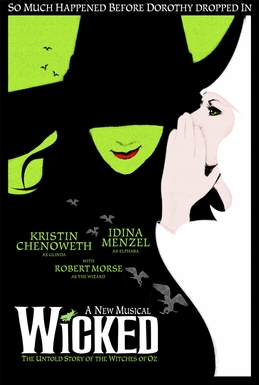
Wicked premiered on Broadway in 2003, two years after I first moved to New York. Last month, more than a decade after its premiere, I finally went to see the show. The musical is still playing to sold-out crowds at the Gershwin Theatre so you don't really need me to tell you to watch it. But, in case you're a procrastinating New Yorker like me, I'm going to anyway.

The show is based on Gregory Maguire's novel Wicked: The Life and Times of the Wicked Witch of the West. I read this book in college and couldn't understand why the musical was such a huge hit if it was based on such a massive and (in my opinion) dull tome. Thankfully, the musical takes extreme liberties with the story, resulting in a delightful and whimsical two and a half hours of musical theater. The story follows Glinda and Elphaba, the two girls who will grow up to become the Good Witch of the South and the Wicked Witch of the West who meet Dorothy during her adventures in The Wonderful Wizard of Oz. The green-skinned Elphaba is shunned by her family and schoolmates, but she has extraordinary powers of sorcery. She is a kind-hearted girl, who wants to stand up for the downtrodden, but over the course of the musical, we will see how her good intentions go awry and she transforms into the much misunderstood Wicked Witch. In the meantime, Glinda is a perky blonde, who lacks Elphaba's talent but has oodles of personality. We get to see how she navigates Oz's power structure to become the Good Witch and how her relationship with Elphaba matures over the years.

It's a complicated and powerful story about what it really means to be good or wicked and how much morality is in the eye of the beholder. But if you don't want to get deep, it is also a fantastic Broadway musical, brimming with beautiful costumes, stunning sets, and of course, one of the greatest scores ever performed on the Broadway stage. You can listen to the original Broadway cast recording with the powerhouse vocals of Idina Menzel and Kristin Chenoweth, but the songs only truly sink in after you've watched them live on stage. I need to especially highlight Jenni Barber, who is currently playing Glinda on Broadway and delivered a brilliant rendition of "Popular." While no one could match Kristin Chenoweth's vocal prowess, Barber lent so much comic flourish to this song and added so many extra bits and side gags that it became a hysterical masterpiece.

That's the reason people keep returning to watch this show (and other Broadway gems) multiple times. The power of live theater is that it's constantly evolving, never stale, and the performance I saw will be completely different to what you see. However, Wicked has a solid foundation, with an intriguing story, brilliant music, and a tantalizing mix of comedy, drama, satire, and romance. The show seamlessly weaves in familiar elements from the Wizard of Oz in surprising ways that will delight any fan of that story, and everything is wrapped up rather beautifully at the end. It's a wonderful tale and well worth all the hype.

Saturday, September 6, 2014

Coupling: Sexier British Friends

I first saw Coupling over a decade ago. PBS was randomly airing the series on Friday night (as is PBS's wont) and I instantly became hooked to this quirky British sitcom (as is my wont). As a huge Friends fan, Coupling was guaranteed to appeal to me, since it followed a group of six friends in London. However, thanks to the liberality of British television and the genius of creator Steven Moffat, these friends are infinitely more bizarre, witty and sex-crazed than the ones you've seen on American TV.

Steve and Susan (modeled after Steven Moffat and his wife Sue Vertue) are the central couple of the group. The pilot features their first date and we subsequently follow their relationship along four seasons. Steve (Jack Davenport) is a relatively sensible but typically insecure man, flummoxed by women and prone to hilarious rants about the feminine fascination for cushions or shoes. Susan (Sarah Alexander) is incredibly sensible and prone to frustration with her indecisive beau, so she struggles to patiently guide him along their relationship. Steve's best friend is Jeff (Richard Coyle), a bizarre Welshman who is obsessed with women yet terrified to talk to them and gets into the most unimaginably horrific and hilarious scrapes. Susan's best friend is Sally (Kate Isitt), a beautician who is terrified of growing old, being single, and bottom spreadage. Rounding out the cast are Jane (Gina Bellman) and Patrick (Ben Miles), Steve and Susan's promiscuous exes who manage to become entrenched in the group and get entangled in their various machinations. 

Like with Happy Endings, don't get hung up on the premise and instead focus on the execution. In the case of Coupling, the fact that Steven Moffat wrote every episode should be more than enough of a recommendation. Double entendres are flying, insanely complicated misunderstandings abound, and each episode is so densely packed with jokes and revelations that you can't believe they are just 30 minutes long. The show also has some particularly innovative episodes where they replay a situation from the point of view of multiple characters, or toggle back and forth between the men and the women to highlight the ridiculous gender dynamics at play. It is smart and silly, subtle and outrageous, and always a delight.

I recently re-watched the entire series on Netflix and found it endlessly fascinating. Despite having seen each episode multiple times in the past, I still picked up new jokes I had missed, or new innuendos that I didn't quite understand as a teen. Being a British show, there are just 28 episodes to enjoy, but each one is a gem, even the six episodes of the fourth season where Jeff was abruptly replaced by a wacky man called Oliver (Richard Mylan) since Richard Coyle left the show. Coupling didn't go past four series because Moffat got busy with Doctor Who, but to my joy, I just discovered that he wrote on a message board in 2006, to offer fans of the show some resolution as to what happened to all the characters. So load up your Netflix queue and get cracking. You are not complete until Jeff teaches you about the "Giggle Loop" and Steve has explained what the women of the world have been doing with their stockings. 

Sunday, August 31, 2014

Begin Again: Music & Second Chances in New York

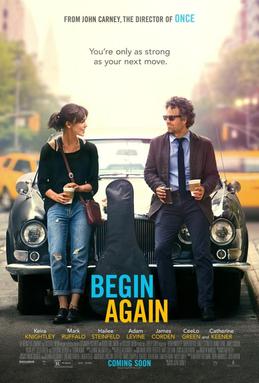
Over Labor Day weekend, AMC is offering free tickets to see Begin Again in participating movie theaters. I snatched up two tickets on Friday and my friend and I went in with fairly low expectations - after all, if they were resorting to free ticket promotions, how good could the movie be? Turns out, really good. If the intention of this promotion is to increase word of mouth, they certainly succeeded, because I'm here to tell everyone to watch this movie.

The central characters are the talented but unassuming songwriter Gretta (Keira Knightley) and the alcoholic and down-on-his-luck music producer Dan (Mark Ruffalo), with New York City contributing a great deal in the background. The movie begins with Gretta's best friend Steve (the always delightful James Corden) forcing her to sing one of her songs at an open mic night in an East Village bar. As she reluctantly sings, Dan, who just stopped in to have a drink, is mesmerized and decides that he needs to sign Gretta on as an artist for his label.

The first half of the movie unfolds mostly in flashbacks. We see how Gretta arrived in New York from the UK with her pop star boyfriend Dave (a hilariously well-cast Adam Levine) and the gradual dissolution of that relationship. We learn how Dan went from being a Grammy award-winning producer to a complete shambles of a human being who is an embarassment to his estranged wife and daughter (Catherine Keener and Hailee Steinfeld, both putting in remarkable supporting performances). And after establishing the mess that both these characters are in, the movie generously give them a second chance to build themselves back up and make beautiful music. 

Writer-director John Carney is the man responsible for Once, and he is a master of making movies about music and real people. The movie is slyly devious, threatening to slip into Hollywood cliche, then thwarting the audience's expectations to deliver a funny and heartfelt movie. The relationships don't pan out in typical rom-com fashion and are instead grounded in genuine human emotion. Keira Knightley and Mark Ruffalo are impeccable and the supporting cast is thoroughly delightful, elevating the movie in every scene. Gregg Alexander is responsible for the movie's evocative soundtrack and he has captured every character's personality to give the movie an added layer of authenticity. 

Begin Again was initially released in June and got lost in the morass of big-budget summer blockbusters. However, by re-releasing it now, in the quieter fall months when quality independent movies can be discovered more easily, The Weinstein Company is wisely courting more attention for this gem of a movie. Therefore, if you have no plans this Labor Day, head to your local theater and watch Begin Again. Then tell all your friends to do so and ensure this movie gets the attention it so rightfully deserves. 

Friday, August 22, 2014

Happy Endings: Spectacular Sitcom Shenanigans

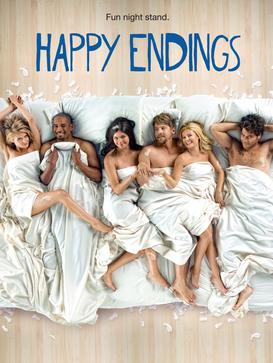
Happy Endings aired on ABC from 2011 to 2013. During that time, it was critically acclaimed and adored, with many people begging audiences to tune in and boost the show's ratings. Sadly, I, like many others, did not pay attention, and the show was ignominiously cancelled. However, it has subsequently developed a cult following among people who discovered it online and on demand. Over the past month, I've binged through the entire run of Happy Endings and discovered a show that is wonderfully witty, sweet, and entertaining.

Stop me if you've heard this premise before: a group of six friends have adventures and fun times in an American city. Sure, it seems old hat, but Happy Endings delivers in its execution. The main characters are ditzy blonde Alex (Elisha Cuthbert), whose sister is the hyper-organized blonde Jane (Eliza Coupe), who is married to the put-together but laid-back Brad (Damon Wayans Jr.). Alex was supposed to marry Dave (Zachary Knighton) but she jilted him at the alter in the very first episode, which leads to a fair amount of confusion as they try to remain friends without descending into bitter arguments at every get-together. Dave is Alex's male ditz equivalent who owns a food truck and lives with Max (Adam Pally), a gay slob who is always looking to make a quick buck without actually being employed. The final member of the group is Penny (Casey Wilson), who grew up with Alex, Jane, and Dave, dated Max in college until she discovered he was gay, and is now perpetually on the hunt for a boyfriend. It's a fantastic cast of characters who initially seem like tropes but quickly reveal themselves to be far more zany and bizarre than anyone you've seen on traditional sitcoms.

The quality of the writing on this show is incredible. It's a constant barrage of jokes, and the cast has an "amahzing" rhythm and chemistry that allows them to sustain His Girl Friday-esque levels of high-speed banter. This is a show you could re-watch multiple times and still catch layers of jokes you missed the first time around. The jokes can be silly, sophisticated, satirical, or self-referential, but you are guaranteed at least one gut-busting laugh per episode. And apart from verbal dexterity, the cast excels in physical comedy (particularly Casey Wilson), which allows for even more comic gags. There is also a great deal of warmth and heart to the show, which often bursts out in the season finales and makes it so satisfying to watch.

Happy Endings should have stayed on TV for multiple seasons. It suffered from poor marketing and the hyper-competitive nature of network television that never really gives comedies a chance to find an audience. Thankfully, we at least have 57 episodes to indulge in. I urge you to seek out this show, and then seek out anything this cast does from here on out. They may no longer be able to make us laugh as a group, but they're still out there making comedy.