Friday, March 24, 2017

Beauty and the Beast: A Timeless Tale

When Disney released the live-action Cinderella in 2015, I was sceptical. Why would we need a live-action re-imagining of an animated classic except as a corporate money-spinning venture? However, once I saw the movie, I sang a different tune. And thus, I found myself in the theater this week, excited to watch Beauty and the Beast come to life in truly glorious Disney fashion.

The top reason to watch this movie is Sarah Greenwood's production design. Every architectural swirl or elegant stick of furniture looks like someone put all their effort into perfecting it, and the result is a jaw-dropping fairy-tale world that is almost better than anything you could see in an animated film. The Beast's castle is simply magnificent, full of dark and twisty staircases and frivolous flourishes that make it look both foreboding and inviting in equal measure. Jacqueline Durran's costumes are similarly fantastic, and when Belle walked out in that yellow gown, I literally sighed in envy. I have never been the sort of person who wants to buy things they see in movies (OK fine, I did buy the One Ring), but oh what I wouldn't do to wear that dress.

The next reason to watch the movie is Emma Watson. I found her utterly bewitching throughout the film, and I am perplexed as to why people are being so lukewarm about her singing and/or acting abilities. As far as I'm concerned, it's a masterstroke of casting. Belle is a beautiful bookworm, and who better to play her than a Goodwill Ambassador for UN Women who played Hermione Granger in eight movies and has lately been on a crusade to share literature around the world as part of her feminist book club? Personally, any character who falls in love with a library before she falls in love with a man is my kind of heroine, so I was thoroughly on board for this performance. Dan Stevens is also great as the Beast, though one can't help but think there must be an in-joke involved in making one of Downton Abbey's dreamiest men unrecognizable as a hairy monster for an entire film. Of course, his inner charm and wit shine through, which I suppose is the lesson I was meant to be learning from this story instead of lusting after Belle's wardrobe.

The supporting cast is fleshed out with voice acting from the likes of Ewan McGregor (as Lumiere the candelabra), Ian McKellen (Cogsworth the clock), Emma Thompson (Mrs. Potts the teapot), Audra McDonald (the wardrobe, Madame de Gardrobe), Stanley Tucci (the harpsichord, Maestro Cadenza) and Gugu Mbatha-Raw (Plumette the feather duster), and real-life acting from Kevin Kline (Maurice, Belle's father), Luke Evans (impressively bulked up to play the detestable Gaston), and Josh Gad (Gaston's sidekick, Le Fou, the now-infamous "gay" character, who is causing an uproar for no discernible reason whatsoever). It's an impressive bunch and they all acquit themselves in fine fashion apart from some truly terrible French accents from Audra McDonald and Ewan McGregor (who is tolerable when speaking but becomes increasingly Scottish when singing). And when Emma Thompson starts to warble "Tale as old as time," you'll be hard-pressed not to get a little misty-eyed.

Beauty and the Beast isn't particularly innovative and is quite faithful to the original 1991 animated film. However, it does throw in more backstory for both Belle and the Beast, fleshing out their characters and giving us a better sense of why they turned out the way they did and why they are ultimately perfect for each other. The musical numbers are wonderful to watch but less wonderful to listen to - it can be difficult to make out the words so I would suggest you lean back and revel in the visual splendor instead. This is a movie that caters to your nostalgia but also lets you experience the story in a fresh and dazzling way. I have always been a fervent advocate of the black-and-white 1946 Jean Cocteau film, La Belle et la Bete, which was the inspiration for Disney's movie. But now in 2017, it continues to inspire filmmakers, and while some may choose to complain that we're merely getting multiple versions of the same story, I choose to celebrate the fact that we are getting multiple versions of a story that I will never tire of watching on screen. 

Sunday, March 12, 2017

Black Mirror: Prescient Television

Despite reading about Black Mirror for years, I had never watched the show. Then after a colleague talked about it for months (thanks Adam!) I finally caved and binge-watched all three seasons of the show on Netflix. It was both terrifying and exhilarating.

The show consists of a series of stand-alone episodes set in the not-too-distant future and dissects the effect of a particular type of technology on society. From the dark and twisted mind of Charlie Brooker, the results are almost inevitably dystopian - the latest season featured one optimistic episode, "San Junipero," but in general, this show takes a fairly bleak and pessimistic view of humanity. This is the modern equivalent of The Twilight Zone, but with high production value, tight scripting, and a whole lot of eerily accurate predictions about our ability to use technology to bring each other down instead of lifting each other up.

The first two seasons aired on the UK's Channel 4 in 2011 and 2013 and consist of three episodes each with a Christmas Special that aired in 2014. But the latest season premiered on Netflix late last year, so we got six more episodes of ominous science fiction to whet our appetites. You don't have to watch in order, but if you're a fan of Easter eggs, they do sometimes contain subtle callbacks to previous episodes. And while everyone has their opinions, I personally believe the first season of the show was its strongest and is the best possible introduction. As recommended by my colleague (thanks again Adam!) it might be better to start with the second and third episodes, as they contain more of a science fiction slant and, whilst disturbing, are far less viscerally horrifying than the events that transpire in the first episode. (However, the first episode is the one that made me truly believe in the show's weird omniscience, because despite airing in 2011, it managed to refer to a British political scandal that came partially true in 2015.) The second episode, "Fifteen Million Merits," has the added bonus of starring Daniel Kaluuya, for those of you who have just watched Get Out and need to experience more of this man's incredible acting chops.

If you're not an Anglophile and are going to need a more American introduction to the show, you could do no worse than to start with the first episode of Season 3, "Nosedive," which stars Bryce Dallas Howard and was written by Rashida Jones and Mike Schur, based on a story by Charlie Brooker. It is directed by Joe Wright and features eye-popping production design, a simple but spot-on premise, and captures everything that makes Black Mirror such a tantalizing and creepy show to watch. If you're a Mad Men aficionado, you can then move on to the Christmas Special, which starred Jon Hamm, who has made a habit in recent years of showing up in British shows and being amazing.

After all of the above, I haven't even gotten to my favorite episode, "Be Right Back," which was the Season 2 opener. Starring Hayley Atwell and Domhnall Gleeson, it is beautifully shot, acted, and scripted, and will wallop you with emotional sucker punches from beginning to end. Like the best Black Mirror episodes, it is set in a world that is completely like ours, but has one form of advanced technology that is so emotionally resonant that it becomes a dangerous human liability. So follow me down the deep, dark rabbit hole of Black Mirror. Not every episode is a sure-fire hit, but when you find the one that speaks to your soul, you will never forget it.

Friday, March 10, 2017

Get Out: The Horror of Racism

Has everyone recovered from the Oscars? Good. Now grab a friend and get back to the movie theatre to watch Get Out.

Written and directed by Jordan Peele (of Key & Peele fame), Get Out is the story of what happens when Chris (Daniel Kaluuya), a black man, agrees to visit his white girlfriend's parents for the weekend. His girlfriend, Rose (Allison Williams), is extremely nonchalant and dismisses Chris's concerns that her parents will be shocked when they find out she has a black boyfriend. "My father will tell you that he would have voted for Obama for a third term," she tells him while rolling her eyes. As far as she's concerned, her parents are embarrassing, not racist.

Their weekend excursion begins innocently enough, and Rose's parents (played by Bradley Whitford and Catherine Keener) seem like perfectly nice, welcoming people. And yet, as you might know from the trailers and from literally everyone who has seen this movie in the past two weeks, this is a horror movie. Before long, Chris becomes increasingly discomfited by how weirdly everyone is behaving around him, and while Rose seems to think he's being paranoid, he cannot shake off the feeling that something is not quite right. The only other black people in the house are the gardener and housekeeper, and every time Chris engages them in conversation, he can't understand why they don't react like the typical black people of his acquaintance. And yet, there's nothing overtly racist or frightening about anything that's happening. It's all lurking under the surface, and that is what makes things so particularly terrifying.

I dare not discuss the details any further because watching this movie unfurl its plot and hurtle towards its thoroughly satisfying conclusion is a joy that should not be denied to any moviegoer. Suffice to say, it is a pitch-perfect film, a profound commentary about the many ways in which racism permeates our society masquerading as a hilarious and bloody horror show. Black audiences will empathize with Chris's discomfort in his predominantly white surroundings and his resignation to the casually racist comments he encounters from every source. White audiences will uncomfortably recognize the weird things they or their families have said to their black friends. And everyone will jump in their seats as plot twist after plot twist is unveiled, even until the very last minute, when Jordan Peele turns your final race-based assumption on its head.

No review of this movie is complete without highlighting the superb performances that anchor this film. Daniel Kaluuya is an absolute marvel, the perfect audience surrogate who draws you into his every thought and action and has you rooting for him from the very first minute. Allison Williams is impeccable as the clueless Rose, a seemingly woke white lady who is still blind to her family's bizarreness. Bradley Whitford and Catherine Keener are captivating, playing off their carefully cultivated white liberal actor images until their endgame is shockingly revealed. And special shoutouts to Betty Gabriel, Marcus Henderson, and LaKeith Stanfield, the only three black people Chris meets at Rose's house, who are delivering surreal, silent performances that only make sense once the plot is fully explained.

Get Out is a veritable onion of a movie - you keep peeling away and discover more witty and insightful layers that you missed the first time around. Even after knowing the plot, you could re-watch it multiple times to revel in the artistry of every scene and every piece of dialogue. It is insanely incisive and wonderfully funny. And it is also frightening - but less because of blood and gore, and more because of the way it reveals how racism is baked into our society in insidious ways we have never fully appreciated.

Saturday, February 25, 2017

And the 2017 Oscar Goes To...

It's time for the third installment in an annual Pop Culture Scribe tradition: my Oscars blog post, where I discuss all the movies and people I would love to see taking home an award. While the world is in disarray, Hollywood forges on, and though the night is sure to prove full of incendiary political speeches, I am simply keen to celebrate the escapism that cinema has afforded me in a particularly heinous year. So let's sally forth and see who brought us the most cinematic joy.

Best Picture: This is a surprisingly difficult category for me this year. The nominated films feel like a pointed response to last year's #OscarsSoWhite debacle, featuring a slightly more diverse and empathetic array of stories and performances. Most signs point to La La Land, and I would not begrudge its win at all. In a year full of terrible news, it was a shining beacon of art and beauty that managed to be both fantastical and poignant at the same time. But then you have movies like Manchester by the Sea, Fences, and Hell or High Water, that featured searing performances, gripping dialogue, and were divine. Then there were biopics like Hidden Figures, Lion, and Hacksaw Ridge, that made you believe people could accomplish extraordinary things. However, if I had to pick a film that moved me and truly transported me, it would be a tie between Moonlight and Arrival. I cannot think of two more diametrically opposed films - one is a three-act story of a black boy growing up in Miami, the other is the tale of a cognitive linguist attempting to talk to aliens and save the human race. And yet both feature powerful central performances, deft direction, stunning cinematography, and stirring scores. All of the nominated movies were great this year, but those two are my pick for the most magnificent of the bunch; they are as close to perfect as movie-making gets.

Best Director: Anyone but Mel Gibson. La La Land, Arrival, Moonlight, and Manchester by the Sea are the four best movies I saw this year, and I would be happy with a win for any of those directors. Damian Chazelle probably deserves it for La La Land as it would have been the greatest challenge in terms of directorial logistics. He didn't just film his actors talking, he also had to shut down a California freeway and film dancers pirouetting on cars in the baking heat. But Barry Jenkins would be the first black director to win an Oscar and no one could argue with his directorial wizardry in Moonlight. So give him an Oscar to make up for the fact that he might not win Best Picture.

Best Actor: Casey Affleck seemed to be the favorite for Manchester by the Sea, and I wouldn't dispute that from an acting standpoint (sexual harassment allegations are another story). But Denzel Washington could beat him out with that incredible performance in Fences, and while I ordinarily prefer awarding first-time winners, Denzel would be the first black person to win three Oscars. That would make the night rather more special that awarding a white misogynist. But the three remaining actors, Viggo Mortensen, Andrew Garfield, and Ryan Gosling are all sentimental favorites of mine, and I would be secretly ecstatic if any of them won. The Mortensen and Garfield performances anchor their respective movies and are what elevated Captain Fantastic and Hacksaw Ridge to Oscar caliber, while Gosling deserves an Oscar because there is no other current Hollywood actor who has the charm and grace to pull off that La La Land performance. However, it's impossible, so while I dream about a three-way tie, I shall wait to see if Affleck or Washington are the actual winners on Sunday.

Best Actress: First off, Amy Adams was robbed. We all love Meryl, but I would replace Streep's nomination for Florence Foster Jenkins in a heartbeat for Adams' work in Arrival and then give her the Oscar. As that is not an option, I'll have to go with my second-favorite performance of the year: Emma Stone in La La Land. Much like her co-star, I can't imagine any other actress who could have sashayed into that movie with such aplomb. While much has been made of her audition scene at the end of the movie, it's her audition scene at the beginning that wowed me at the outset. Taraji P. Henson was a delight in Hidden Figures, while Natalie Portman and Isabelle Huppert completely commanded the screen in their respective performances in Jackie and Elle. But Emma Stone was the one who made me forget it was a performance and let me revel in the character and her story. Give the woman an Oscar.

Best Supporting Actress & Actor: These are a lock for Viola Davis and Mahershala Ali, and deservedly so. Their performances in Fences and Moonlight were indescribably affecting and they should get the award. But again, as I keep re-iterating throughout this post, the other nominees were pretty great, and while a win for anyone else would be a surprise, it would not be particularly upsetting.

Best Original Screenplay: It seems like Damian Chazelle has the edge here for La La Land, but I would argue that if we're truly talking about "originality," the rightful winner would be Yorgos Lanthimos and Efthymis Filippou for The Lobster. I mean come on, that movie was absolutely bonkers in terms of its premise and yet managed to be funny and heartbreaking. I would also argue for Taylor Sheridan's Hell or High Water, by far the screenplay with the wittiest insight and dialogue this year. Then we have Mike Mills' and Kenneth Lonergan's equally moving scripts for 20th Century Women and Manchester by the Sea. Oh who am I kidding, just give everyone the prize, they all wrote something incredible.

Best Adapted Screenplay: I don't see Arrival winning anything else, so this is the category where I'm hoping Eric Heisserer has a shot at getting this movie some awards love. But a win for Barry Jenkins and Tarell Alvin McCraney for Moonlight is more likely and perfectly acceptable.

That's all for the major categories I care about. The only other award that truly matters to me this year is to ensure Justin Hurwitz, Benj Pasek, and Justin Paul win Best Original Song for City of Stars, because that song has been stuck in my head for months now and I still love it. Though there's a strong chance that the two songs nominated from La La Land will split the vote and we could end up with a win for Lin-Manuel Miranda (which would be awesome as it would complete his EGOT), or Justin Timberlake (which would be a travesty and might result in me throwing something at my TV). So let's see what tomorrow night brings. I don't anticipate being too disappointed, but I'm certainly curious to see how the Academy feels about the world in general and movies in particular this year. 

Thursday, February 23, 2017

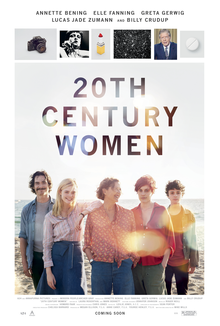
20th Century Women: A Guide to Parenting

Before watching 20th Century Women, the most important fact to note is that it is based on the real-life experiences of writer-director Mike Mills. Raised by his single mother, this movie is an ode to an unconventional upbringing, and you will find laugh-out-loud moments, thought-provoking moments, and moments that bring a lump to your throat.

Set in Santa Barbara, California, in 1979, this is the story of young Jamie (Lucas Jade Zumann), who is being raised by his divorced mother, Dorothea (Annette Bening). She rents the rooms in their house to a hippie named William (Billy Crudup) and a punk music-loving photographer, Abbie (Greta Gerwig). Julie (Elle Fanning) is Jamie's childhood friend who spends all of her time at his house to get away from her therapist mother, who is too busy solving others teens' problems to realize that her own daughter is spiraling. When Dorothea realizes that her son is turning into a difficult teenager and she doesn't know what to do with him, she turns to Abbie and Julie for help. Her logic is that they know him best and can talk to him in a way that a mother can't. Therefore, they must share their life experiences with him and help him through this phase of his life.

What follows is a sweet, funny story about what happens when a group of women teach a boy how to become a man. Abbie shares all of her feminist literature with Jamie, which is both educational and hilarious as it leads to fistfights with other boys over their poor understanding of female sexuality. Julie shares stories of her sexual exploits, all while rebuffing Jamie's advances because she wants them to remain friends. Dorothea loves him dearly but, like all parents, she is not infallible, and she struggles to find the right balance between trusting her son and disciplining him. The two of them try to regain their footing, striving to find a way to talk to each other about important things without arguing. As the supporting players chip in to do their part, the result is a warm and wise film that chronicles how parenthood is an endless parade of mistakes borne out of love.

The three women in this movie deliver outstanding performances. Bening exudes wisdom and kindness in every frame, saying so much with her eyes even when her dialogue is delivered quietly with a minimum of angst. Gerwig is spectacular as Abbie, portraying a strident feminist you would actually want to have meaningful conversations about the patriarchy with while you are doubled over with menstrual cramps. And Fanning continues to be one of my favorite young actresses today, delivering a sweet and honest performance as a young teenage girl who is trying to figure out her life, and is self-aware enough to not hurt Jamie but still hurt herself.

Shot vibrantly by cinematographer Sean Porter, with beautiful production design by Chris Jones, and steeped in literary and lyrical references to the 70's, this movie may be about a very specific period in time but tells a story that feels universal in scope. Everyone will be able to relate to some part of this story, whether it's the teenage angst, the parental pain, or discovering your identity through books, music, or interesting new people. 20th Century Women is a quiet movie that hasn't gotten much fanfare, but like most quiet movies, it speaks loudest to your heart.

Tuesday, February 21, 2017

Elle: A Woman's Revenge?

I watch a lot of movies, and yet sometimes I despair that my tastes are entirely too prosaic. Having grown up on a steady diet of Bollywood films and then graduating to golden age Hollywood musicals and eventually modern Hollywood, I have always made an effort to steep myself in both independent cinema and commercial blockbusters. However, European cinema continues to be a hit-or-miss experience. While Germany's Toni Erdmann was one of my favorite movies this year, watching France's Elle was a much more challenging endeavor.

The movie is the story of Michele (Isabelle Huppert), a divorced woman who, at the very beginning, is raped in her house by a masked man. She spends the rest of the film trying to figure out who her rapist was and then plays an extremely dicey game of cat-and-mouse with him once his identity is revealed. And I can't believe I'm saying this, but it's a pretty funny movie if you can ignore the rape part. Which may be my issue with the film. I don't have the stomach for rape scenes, and this movie is constantly shocking you by flashing back to the event and giving you different perspectives on it. While I understand it is necessary for characterizing the PTSD most rape victims suffer in the aftermath of the event, it is a rather relentless cinematic experience. Even outside of the rape, this is an exceedingly violent movie, as Michele is a video game developer and therefore is involved in creating gratuitously bloody games, and also has a terrifically disturbing back story where her father went on a murderous rampage when she was ten years old. All of this might explain why she chooses to address the rape in the unconventional way she does, but it doesn't make me feel any better about it.

I won't spoil the rest of the movie, but suffice to say, Michele is both forthcoming and reticent about her horrific experience, choosing to divulge the details to certain people but then being secretive about other aspects of it. If it wasn't in French, I would have completely given up on it, but there's something about the Gallic sense of existential ennui that makes this approach to violation seem understandable. You uncomfortably chuckle at the funny moments and then realize you're not quite sure why you're laughing when none of this is OK. But Huppert is delivering such a virtuoso performance that she simply sweeps you along for the ride. Before you know it, the movie is over and you are left contemplating what exactly it is that you just watched.

Ultimately, Elle is a movie I will never watch again, but it is sufficiently intriguing to watch once. It does seem to be a vastly polarizing movie (people either loath it or think it's a masterpiece) but I seem to be mostly ambivalent. I can understand why Huppert has received an Oscar nomination - she is a magnetic presence and throws herself into this role with abandon - but I am entirely too puzzled by what the point of this film is supposed to be. It's written and directed by men (David Birke and Paul Verhoeven respectively, based on the novel Oh... by Philippe Dijan) and perhaps what's lacking is a woman's touch of nuance and empathy in this particular situation. Elle is frightening, funny, exploitative, and dark;  I think I'll stick to watching La La Land. 

Sunday, February 19, 2017

Jackie: A First Lady's Legacy

About fifteen minutes into watching Jackie, you can't doubt why Natalie Portman has received so many nominations for this performance. She owns this movie from start to finish and while I knew very little about Jacqueline Kennedy at the beginning, I certainly felt like I knew her inside and out by the end.

Like the best biopics, Jackie does not go over a sweeping timeline but instead focuses very precisely on John F. Kennedy's assassination and the days leading up to his funeral. The script by Noah Oppenheim is incredibly clever, propelling the story along in an engaging fashion while giving you an insight into Jackie's mind during this tumultuous time. We gather up her life story in bits and pieces through her conversations with a journalist (Billy Crudup), brother-in-law Robert F. Kennedy (Peter Saarsgard), social secretary Nancy Tuckerman (Greta Gerwig), and a priest (John Hurt). She is fragile and firm in equal measure, still in shock after cradling her husband's bloodied skull in her lap, but determined that he must have a true presidential legacy and be remembered for all of the great things that he wanted to accomplish before his life was tragically cut short.

One of the most difficult things to portray on film is a person's mental state. Much depends on the actor, but when the whole point of Jackie is that she retains her outward composure, how do you capture her inner turmoil? Director Pablo Lorrain employs some shaky camerawork, close-ups that let you look right past Portman's outward calm and into her brimming eyes, and scenes where Jackie dazedly wanders around the White House wearing multiple outfits as she contemplates how her life is crashing down around her. But of course, the true indication of Jackie's mental state is the Oscar-nominated score by composer, Mica Levi. It is a jangly, disturbing soundscape that occasionally feels like a traditional score and will then suddenly swoop into unanticipated dissonance that throws you off-kilter. It's rather extraordinary and is an excellent example of how music can add a whole other dimension to a motion picture.

Jackie is a compelling movie, featuring a stunning central performance and a well-paced story that goes behind the scenes of one of the most infamous moments in modern history. Given a choice between this and Hacksaw Ridge, Jackie is the kind of biopic I prefer, intense in its specificity, yet delving so deep into the character that you feel like you have experienced a lifetime with them. The movie is tightly edited and unconventionally narrated, jumping back and forth in time to give you the same sense of unreality that Jackie Kennedy must have been experiencing as these events unfolded. It is well-directed, impeccably scored, and wonderfully-acted. See it.