Sunday, April 23, 2017

The Hike: Homeric Hysteria

I've been binge watching a lot of TV shows lately, but it's been a while since I have felt compelled to binge read a novel. However, thanks to a recommendation from my boss (name-dropped on the blog again, Anthony, how does it feel to be famous?), I found myself feverishly turning the pages of Drew Magary's The Hike and devouring it over a single afternoon. As I got more invested in the story, I grew increasingly terrified that the ending would be a massive let-down. But then I read the final page and knew this book had instantly been elevated into the pantheon of books I will treasure forever.

This novel is impossible to describe (so why I am bothering to write a review? Who knows, I'm a besotted fool.) In very broad strokes, it is the story of a man named Ben, who decides to go for a walk before a business meeting and ends up on a nightmarish journey that is the modern-day equivalent of The Odyssey. He encounters bloodthirsty monsters, talking animals, mysterious crones, and a flirty cannibalistic giant. He spends every chapter desperately fighting for his life and the chance to return home to his wife and three children. Each scenario is more surreal and brilliantly realized than the last, and if you're still in a post-4/20 haze, you might want to wait for the fog to clear, because this book might break your brain. And through it all, most importantly, it is wickedly funny. Ben might be at the end of his rope, but he is never at a loss for words, and as he curses his way through this series of unfortunate events, you can't help but root for him every step of the way.

Drew Magary is a magnificent writer with a searingly vivid imagination. In a few sentences, he can render an entire world and perfectly describe some hideous beast that you've never heard of before but certainly won't be able to forget in a hurry. I didn't know what a Mouth Demon was before 2 pm today, but I sure as hell will have nightmares about it tonight. But the most important part of any fantasy novel is the human element. An author can demonstrate as much competence as possible when describing new frontiers and weird creatures, but if he cannot make you empathize with the plight of the central character, there's no real heart to the story. Thankfully, in Ben, Magary has created the perfect protagonist. He is a modern-day family man, staunchly reliant on his phone to solve all his troubles (Magary's descriptions of the terror of watching an iPhone run out of battery might be the most frightening portion of the entire book), who refuses to give up on this heinous journey until he is reunited with his family. The book is littered with illuminating flashbacks to formative experiences from his youth and funny-sad-romantic passages where he yearns for his wife. I was constantly reminded of Odysseus, fighting his way back to Penelope for years against unimaginable horrors and ordeals. It might seem like a fanciful comparison, but trust me, this book is that good.

The Hike is an unrelenting pleasure. It is wildly inventive, deliriously absurd, and breathtakingly heartfelt, burrowing deep into your soul in a way that you never expect. And as I mentioned at the beginning, it has a glorious finale, a climactic twist that makes everything that came before it that much more poignant. So pick up a copy and hunker down for a few hours. It might seem too strange at first, but believe me, this is a literary journey that you must take.

Wednesday, April 19, 2017

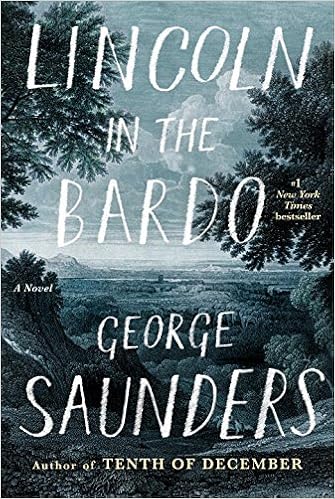
Lincoln in the Bardo: Loss, Grief, and Moving On

It took me two weeks to read Lincoln in the Bardo. I kept trying to fit it into my commute, reading snatches of it on the bus and subway, and constantly puzzling over whether I was actually enjoying this novel or was thoroughly mystified by it. However, when I read the final chapters this weekend, I realized this book was a masterpiece.

I already made my love for George Saunders' short stories clear when I reviewed Tenth of December three years ago. At the time, I was astonished at how this man could pack an entire world into a few brief pages and build a complete history with some truly bewitching prose. However, a novel is a very different proposition, and part of my difficulty with getting into Lincoln in the Bardo stemmed from the fact that while it is meant to be one story, it often felt like a lot of disparate short stories woven into one narrative thread. This was initially frustrating, but watching it coalesce into a glorious whole was a pretty extraordinary literary experience.

The book is set in a cemetery and tells the story of the night following the death of Abraham Lincoln's young son, William. It contains snippets of actual historical information collated from various first-hand witnesses of the President's grief. But the majority of the story is told by the ghosts that are prowling around the cemetery, the poor souls who are stuck in Purgatory because of their stubborn insistence to remain on earth and deny their deaths. If that sounds bizarre, believe me it is, and it takes a lot of getting used to. But eventually Roger Bevins III, Hans Vollmann, and the Reverend Everly Thomas feel like old friends, and as they slowly let bits of their history slip out, you understand what it is they are clinging to from their past lives, but why it is more important for them to move on.

The book is ultimately a meditation on death and grief, which is not my first choice of literary fare. However, it deploys its wisdom cunningly, masking its true colors through the funny and profane asides of the multiple ghosts who are trying to figure out what to do with Willie Lincoln and his grieving father. Which brings me to the final chapters. That is when the book truly becomes a story about Abraham Lincoln, the ordinary man and heartbroken father, who will learn from this moment and go on to lead a nation during a bloody Civil War. It's not like we don't know Lincoln was a great man, but by choosing to focus on this devastating period in Lincoln's life, Saunders captures the fragility and raw humanness that fueled much of his greatness. When the ghosts of black slaves enter the narrative, you start to realize how cleverly Saunders has sucked you into this world and given you a valuable history lesson under the guise of fantastical fiction.

Lincoln in the Bardo is a subtle book. Every sentence is crafted with Saunders' trademark flair, alternating between hilarious and heartbreaking. It is certainly not an easy book to read, and there are long stretches that meander off into tangents and concern characters that don't really seem worthwhile. But stick with it. Because despite the weird territory it strays into, it ends with a moving profundity that makes the journey worthwhile.

Sunday, April 16, 2017

Better Call Saul: Prequel Perfection

When Better Call Saul premiered two years ago, I remember watching the black-and-white opening scene, featuring Saul in hiding as a Cinnabon manager following the events of Breaking Bad. And then I stopped watching because I decided there was no way this show could match up to the explosive brilliance of Breaking Bad. However, after my boss wouldn't stop talking about it (thanks Anthony!), I saw the pilot episode on Netflix last weekend. And three days later, I blinked my bleary eyes and discovered I had mainlined twenty episodes and was all set for the Season 3 premiere.

Watching this show has been such a whirlwind that I'm still trying to pinpoint what exactly made me binge watch it with such fanaticism. The key reason is likely the writing: considering Vince Gilligan is at the helm (along with co-creator Peter Gould, who wrote the first Breaking Bad episode to feature Saul Goodman), I should have known this show would be a writer's delight. Upon trying to describe the show later to a friend, all I could say was that it is like reading a novel, except it's taking place on screen. Much like Breaking Bad, every episode ends on an agonizing cliffhanger, which makes clicking on "Play Next Episode" the only sensible choice. And within each episode, you will be treated to quippy dialogue, fast-paced action, and gradual mysteries that unfold over the course of silent minutes, episodes, or an entire season. 

Of course, this storytelling excellence requires the support of an amazing cast, and after you watch a couple of episodes, there's no surprise that they chose to give Bob Odenkirk this spin-off prequel. He plays Jimmy McGill, the man who will eventually become Saul Goodman, and watching this character's origin story is a reminder of how much we take supporting characters for granted. While I always relied on Saul for some comic relief, I never thought twice about how exactly this seemingly goofy but nice guy became a lawyer adept at facilitating money laundering and covering up heinous crimes. Now that I've watched two seasons of Better Call Saul, however, his psychological make-up is becoming clearer by the minute. And lest I forget, Jonathan Banks is back on this show as Mike Ehrmentraut (he is also the only actor who seems immune to the makeup department's de-aging wizardry; let's face it, he was born looking like a stoic old man), and his back story is proving to be just as enlightening.

I was afraid Better Call Saul would be too gimmicky, but it is in fact proving to be a singular sensation, able to stand completely on its own merits, whilst still weaving in the elements that made Breaking Bad such a groundbreaking piece of television. I hadn't realized how much I missed the cinematic landscape of Albuquerque, New Mexico, until I saw those miles of blue sky and desert wasteland, and the music choices are spot on as ever. The costume and set design are particularly adept, as is the wig department's efforts to keep the audience in touch with what timeline we're in by altering Odenkirk's hairline. And apart from Banks and Odenkirk, full kudos are due to Rhea Seehorn, Patrick Fabian, and Michael McKean, the new supporting actors who have been so expertly cast that you won't realize all the pre-conceived notions their casting brings to bear until you are at the end of Season 1 and everyone's motives are flipped on their heads.

TL;DR: Better Call Saul is worthy of all the hype, and if you have been procrastinating like I was, cancel all your weekend plans and binge it with a vengeance. You will get drama, mystery, comedy, romance, action, murder, legal manipulations, sibling rivalries, and everything else under the sun. It is a cornucopia of television excellence and the sooner you begin, the sooner you can learn what the rest of the world has been delighting in for the past two years. 

Tuesday, April 4, 2017

Big Little Lies: The Devil Is in the Details

Like many Americans, I spent my Sunday counting down the minutes till the Big Little Lies series finale would air on HBO. And unlike most highly anticipated events, this one did not disappoint. Based on the best-selling novel by Liane Moriarty (which I am now waiting to get from the library), the show consists of seven perfectly executed episodes. Each is a work of cinematic genius in its own way, but taken together, the sum transcends the parts. And this is mostly due to three things: the acting, the writing, and the directing.

Let's begin with the writing. The series was created and written by David E. Kelley, and while I never watched his earlier television work (Ally McBeal, The Practice, Boston Legal, etc.) I now get the sense that I might have missed out. This show is essentially a murder mystery, with the first episode titled, "Somebody's Dead." But the magnificent conceit is that despite various scenes with the detective interrogating members of the community about the murder, you will not find out until the seventh episode who is dead and who killed them. Instead, the show introduces us to a rich cast of characters, and by picking apart their lives and their psyches, invites us to solve the mystery ourselves. In fact, by the time you get to the denouement, you will be shattered by how obvious and inevitable the conclusion seemed. And yet, that obviousness isn't disappointing - instead it is wonderfully satisfying, almost like Kelley has been putting together a massive jigsaw puzzle, and that last open spot has finally been filled in with the missing piece. I don't know how much of this is attributable to the original novel and how much is Kelley's own personal wizardry, but either way, it is a stunning adaptation.

The cast is an embarrassment of riches, boasting Oscar winners and nominees who are all at the top of their game. Leading the fray is Reese Witherspoon as Madeline McKenzie, an interfering but well-meaning stay-at-home mom who likes to fix everyone's problems while her own seemingly idyllic life, with husband Ed (Adam Scott) and daughters Abigail and Chloe (Kathryn Newton and Darby Camp), spirals out of control. Then there's Nicole Kidman as Celeste Wright, a woman living the dream with a devilishly handsome younger husband (Alexander Skaarsgard) and two cherubic twin boys. However, as the series progresses, her life crumbles in a way that is simply gutting. Shailene Woodley plays Jane Chapman, a single mother with a mysterious past, who has issues that need to be dealt with while she struggles to build a new life for herself and her son. Laura Dern plays the successful Silicon Valley CEO, Renata Klein, a working mother who is trying to Lean In and have it all, with spectacularly unsuccessful results. And finally there's Zoe Kravitz as Bonnie Carlson, the younger woman who married Madeleine's ex-husband, Nathan (James Tupper), and who embodies the chilled-out vibe of Monterey that none of these other mothers can emulate.

Last but certainly not least, we come to Jean-Marc Vallee, the sole director of all seven episodes. This show would be nothing without the script and the cast, but you need a visionary director to elevate those components to such a pinnacle of televisual delight, and Vallee has delivered in spades. His crew is stocked with the best of the best: stunning cinematography by Yves Belanger, a pitch-perfect soundtrack by music supervisor Susan Jacobs, and impeccable production design by John Paino, particularly in the final episode when things comes to a head at a school trivia night that has an Elvis and Audrey Hepburn theme (special shout out to costume designer Alix Friedberg for those Hepburn outfits: Reader, I swooned.)

Big Little Lies is a marvel, a reminder of how blessed we are to be in the golden age of television where we can get cinematic excellence on the small screen. I cannot imagine what a dismal failure it would have been to try and cram this story into a feature-length film. Instead, HBO allowed the producers to tell the story in a well-paced seven episodes that engendered nail-biting speculation, awe, and emotion. I have rarely seen a more symbiotic blend of plot and character: usually I find that a show relies more heavily on one or the other, but in this case, both elements were inextricably intertwined, with character development informing the plot and vice versa.

Two days after watching the finale, I am still trying to wrap my head around how exactly they pulled this off. The series dealt with difficult themes that are rarely portrayed effectively in popular culture, but handled them with grace and astute editing that ensured the audience never felt exploited. I'm deliberately being ambiguous because again, there are only seven episodes, so every detail is a spoiler. But take my word for it. You need to watch Big Little Lies, and once you do, let's discuss it at length, because I still have many thoughts I need to express.

Friday, March 24, 2017

Beauty and the Beast: A Timeless Tale

When Disney released the live-action Cinderella in 2015, I was sceptical. Why would we need a live-action re-imagining of an animated classic except as a corporate money-spinning venture? However, once I saw the movie, I sang a different tune. And thus, I found myself in the theater this week, excited to watch Beauty and the Beast come to life in truly glorious Disney fashion.

The top reason to watch this movie is Sarah Greenwood's production design. Every architectural swirl or elegant stick of furniture looks like someone put all their effort into perfecting it, and the result is a jaw-dropping fairy-tale world that is almost better than anything you could see in an animated film. The Beast's castle is simply magnificent, full of dark and twisty staircases and frivolous flourishes that make it look both foreboding and inviting in equal measure. Jacqueline Durran's costumes are similarly fantastic, and when Belle walked out in that yellow gown, I literally sighed in envy. I have never been the sort of person who wants to buy things they see in movies (OK fine, I did buy the One Ring), but oh what I wouldn't do to wear that dress.

The next reason to watch the movie is Emma Watson. I found her utterly bewitching throughout the film, and I am perplexed as to why people are being so lukewarm about her singing and/or acting abilities. As far as I'm concerned, it's a masterstroke of casting. Belle is a beautiful bookworm, and who better to play her than a Goodwill Ambassador for UN Women who played Hermione Granger in eight movies and has lately been on a crusade to share literature around the world as part of her feminist book club? Personally, any character who falls in love with a library before she falls in love with a man is my kind of heroine, so I was thoroughly on board for this performance. Dan Stevens is also great as the Beast, though one can't help but think there must be an in-joke involved in making one of Downton Abbey's dreamiest men unrecognizable as a hairy monster for an entire film. Of course, his inner charm and wit shine through, which I suppose is the lesson I was meant to be learning from this story instead of lusting after Belle's wardrobe.

The supporting cast is fleshed out with voice acting from the likes of Ewan McGregor (as Lumiere the candelabra), Ian McKellen (Cogsworth the clock), Emma Thompson (Mrs. Potts the teapot), Audra McDonald (the wardrobe, Madame de Gardrobe), Stanley Tucci (the harpsichord, Maestro Cadenza) and Gugu Mbatha-Raw (Plumette the feather duster), and real-life acting from Kevin Kline (Maurice, Belle's father), Luke Evans (impressively bulked up to play the detestable Gaston), and Josh Gad (Gaston's sidekick, Le Fou, the now-infamous "gay" character, who is causing an uproar for no discernible reason whatsoever). It's an impressive bunch and they all acquit themselves in fine fashion apart from some truly terrible French accents from Audra McDonald and Ewan McGregor (who is tolerable when speaking but becomes increasingly Scottish when singing). And when Emma Thompson starts to warble "Tale as old as time," you'll be hard-pressed not to get a little misty-eyed.

Beauty and the Beast isn't particularly innovative and is quite faithful to the original 1991 animated film. However, it does throw in more backstory for both Belle and the Beast, fleshing out their characters and giving us a better sense of why they turned out the way they did and why they are ultimately perfect for each other. The musical numbers are wonderful to watch but less wonderful to listen to - it can be difficult to make out the words so I would suggest you lean back and revel in the visual splendor instead. This is a movie that caters to your nostalgia but also lets you experience the story in a fresh and dazzling way. I have always been a fervent advocate of the black-and-white 1946 Jean Cocteau film, La Belle et la Bete, which was the inspiration for Disney's movie. But now in 2017, it continues to inspire filmmakers, and while some may choose to complain that we're merely getting multiple versions of the same story, I choose to celebrate the fact that we are getting multiple versions of a story that I will never tire of watching on screen. 

Sunday, March 12, 2017

Black Mirror: Prescient Television

Despite reading about Black Mirror for years, I had never watched the show. Then after a colleague talked about it for months (thanks Adam!) I finally caved and binge-watched all three seasons of the show on Netflix. It was both terrifying and exhilarating.

The show consists of a series of stand-alone episodes set in the not-too-distant future and dissects the effect of a particular type of technology on society. From the dark and twisted mind of Charlie Brooker, the results are almost inevitably dystopian - the latest season featured one optimistic episode, "San Junipero," but in general, this show takes a fairly bleak and pessimistic view of humanity. This is the modern equivalent of The Twilight Zone, but with high production value, tight scripting, and a whole lot of eerily accurate predictions about our ability to use technology to bring each other down instead of lifting each other up.

The first two seasons aired on the UK's Channel 4 in 2011 and 2013 and consist of three episodes each with a Christmas Special that aired in 2014. But the latest season premiered on Netflix late last year, so we got six more episodes of ominous science fiction to whet our appetites. You don't have to watch in order, but if you're a fan of Easter eggs, they do sometimes contain subtle callbacks to previous episodes. And while everyone has their opinions, I personally believe the first season of the show was its strongest and is the best possible introduction. As recommended by my colleague (thanks again Adam!) it might be better to start with the second and third episodes, as they contain more of a science fiction slant and, whilst disturbing, are far less viscerally horrifying than the events that transpire in the first episode. (However, the first episode is the one that made me truly believe in the show's weird omniscience, because despite airing in 2011, it managed to refer to a British political scandal that came partially true in 2015.) The second episode, "Fifteen Million Merits," has the added bonus of starring Daniel Kaluuya, for those of you who have just watched Get Out and need to experience more of this man's incredible acting chops.

If you're not an Anglophile and are going to need a more American introduction to the show, you could do no worse than to start with the first episode of Season 3, "Nosedive," which stars Bryce Dallas Howard and was written by Rashida Jones and Mike Schur, based on a story by Charlie Brooker. It is directed by Joe Wright and features eye-popping production design, a simple but spot-on premise, and captures everything that makes Black Mirror such a tantalizing and creepy show to watch. If you're a Mad Men aficionado, you can then move on to the Christmas Special, which starred Jon Hamm, who has made a habit in recent years of showing up in British shows and being amazing.

After all of the above, I haven't even gotten to my favorite episode, "Be Right Back," which was the Season 2 opener. Starring Hayley Atwell and Domhnall Gleeson, it is beautifully shot, acted, and scripted, and will wallop you with emotional sucker punches from beginning to end. Like the best Black Mirror episodes, it is set in a world that is completely like ours, but has one form of advanced technology that is so emotionally resonant that it becomes a dangerous human liability. So follow me down the deep, dark rabbit hole of Black Mirror. Not every episode is a sure-fire hit, but when you find the one that speaks to your soul, you will never forget it.

Friday, March 10, 2017

Get Out: The Horror of Racism

Has everyone recovered from the Oscars? Good. Now grab a friend and get back to the movie theatre to watch Get Out.

Written and directed by Jordan Peele (of Key & Peele fame), Get Out is the story of what happens when Chris (Daniel Kaluuya), a black man, agrees to visit his white girlfriend's parents for the weekend. His girlfriend, Rose (Allison Williams), is extremely nonchalant and dismisses Chris's concerns that her parents will be shocked when they find out she has a black boyfriend. "My father will tell you that he would have voted for Obama for a third term," she tells him while rolling her eyes. As far as she's concerned, her parents are embarrassing, not racist.

Their weekend excursion begins innocently enough, and Rose's parents (played by Bradley Whitford and Catherine Keener) seem like perfectly nice, welcoming people. And yet, as you might know from the trailers and from literally everyone who has seen this movie in the past two weeks, this is a horror movie. Before long, Chris becomes increasingly discomfited by how weirdly everyone is behaving around him, and while Rose seems to think he's being paranoid, he cannot shake off the feeling that something is not quite right. The only other black people in the house are the gardener and housekeeper, and every time Chris engages them in conversation, he can't understand why they don't react like the typical black people of his acquaintance. And yet, there's nothing overtly racist or frightening about anything that's happening. It's all lurking under the surface, and that is what makes things so particularly terrifying.

I dare not discuss the details any further because watching this movie unfurl its plot and hurtle towards its thoroughly satisfying conclusion is a joy that should not be denied to any moviegoer. Suffice to say, it is a pitch-perfect film, a profound commentary about the many ways in which racism permeates our society masquerading as a hilarious and bloody horror show. Black audiences will empathize with Chris's discomfort in his predominantly white surroundings and his resignation to the casually racist comments he encounters from every source. White audiences will uncomfortably recognize the weird things they or their families have said to their black friends. And everyone will jump in their seats as plot twist after plot twist is unveiled, even until the very last minute, when Jordan Peele turns your final race-based assumption on its head.

No review of this movie is complete without highlighting the superb performances that anchor this film. Daniel Kaluuya is an absolute marvel, the perfect audience surrogate who draws you into his every thought and action and has you rooting for him from the very first minute. Allison Williams is impeccable as the clueless Rose, a seemingly woke white lady who is still blind to her family's bizarreness. Bradley Whitford and Catherine Keener are captivating, playing off their carefully cultivated white liberal actor images until their endgame is shockingly revealed. And special shoutouts to Betty Gabriel, Marcus Henderson, and LaKeith Stanfield, the only three black people Chris meets at Rose's house, who are delivering surreal, silent performances that only make sense once the plot is fully explained.

Get Out is a veritable onion of a movie - you keep peeling away and discover more witty and insightful layers that you missed the first time around. Even after knowing the plot, you could re-watch it multiple times to revel in the artistry of every scene and every piece of dialogue. It is insanely incisive and wonderfully funny. And it is also frightening - but less because of blood and gore, and more because of the way it reveals how racism is baked into our society in insidious ways we have never fully appreciated.